

Artificial Intelligence (AI) and Machine Learning (ML) are transforming industries, from healthcare and finance to e-commerce, manufacturing and software development.
According to the World Economic Forum’s Future of Jobs Report 2025, AI and Machine Learning Specialists are among the fastest-growing technology roles projected through 2030.
If you’re planning to build a career in this field, understanding the right learning pathway is essential.
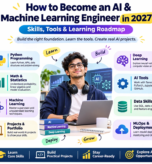
This AI and Machine Learning Engineer Roadmap for 2027 explains the skills, programming languages, technologies and projects needed to get started.
What Does an AI & Machine Learning Engineer Do?
AI and Machine Learning Engineers design, develop, evaluate and deploy intelligent systems that learn from data or use AI models to perform tasks.
Key responsibilities include:
- Preparing and analyzing datasets.
- Developing Machine Learning models.
- Training and evaluating predictive algorithms.
- Building intelligent applications.
- Integrating AI models with software systems.
- Deploying and monitoring AI solutions.
Step-by-Step AI & Machine Learning Engineer Roadmap for 2027
Step 1: Learn Python Programming
Python is one of the most widely used programming languages for AI and Machine Learning development.
Essential Python skills:
- Variables, data types and operators
- Conditional statements and loops
- Functions and object-oriented programming
- NumPy and Pandas
- Data visualization
- File handling and APIs
Practice project: Build a Python application that analyzes student performance data.
Step 2: Understand Mathematics and Statistics
Mathematics provides the foundation for understanding how Machine Learning algorithms operate.
Important concepts include:
- Linear algebra
- Probability and statistics
- Calculus fundamentals
- Descriptive statistics
- Correlation and regression
- Optimization concepts
Beginners can learn mathematical concepts alongside practical programming exercises.
Step 3: Master Machine Learning Fundamentals
Machine Learning enables systems to identify patterns and make predictions using data.
Core topics:
- Supervised and unsupervised learning
- Linear and logistic regression
- Decision trees and random forests
- Classification and clustering
- Model training and validation
- Accuracy, precision, recall and F1-score
Important library: Scikit-learn.
Practice project: Build a customer churn prediction model.
Step 4: Learn Deep Learning and Neural Networks
Deep Learning uses multilayer neural networks to learn complex patterns.
Essential topics:
- Artificial Neural Networks (ANN)
- Convolutional Neural Networks (CNN)
- Recurrent Neural Networks (RNN)
- Transformer architecture
- Model training and optimization
Popular frameworks: TensorFlow, Keras and PyTorch.
Practice project: Develop an image classification application.
Step 5: Explore Generative AI and Large Language Models
Generative AI enables applications to generate text, images and other content.
Key skills include:
- Large Language Models (LLMs)
- Prompt engineering
- Transformer fundamentals
- Retrieval-Augmented Generation (RAG)
- Vector databases
- AI agents and tool integration
- AI model evaluation
Practice project: Build a document-based AI question-answering assistant.
Step 6: Learn MLOps and Model Deployment
MLOps helps developers deploy, maintain and monitor Machine Learning systems.
Important technologies:
- Git and GitHub
- FastAPI
- Docker
- MLflow
- Cloud deployment fundamentals
- Model monitoring and versioning
Learn responsible AI practices, including data privacy, bias assessment and model reliability.
Step 7: Build Real-World AI & ML Projects
A practical portfolio demonstrates your ability to apply AI concepts.
Recommended projects:
- Customer Churn Prediction
- House Price Prediction
- Sentiment Analysis Application
- Image Classification System
- AI-Powered Document Assistant
Document your approach, datasets, evaluation methods, limitations and project results.
Can Beginners Learn AI and Machine Learning?
Yes. Students, non-IT graduates and working professionals can begin learning AI and ML.
However, advanced engineering roles usually require substantial programming, mathematics and practical development skills.
Start with Python and fundamental statistics before progressing to advanced models and deployment.
AI & Machine Learning Career Opportunities
Depending on skills and experience, learners can explore:
- Junior Machine Learning Engineer
- AI Developer
- Machine Learning Engineer
- AI Application Developer
- NLP Engineer
- Generative AI Developer
- AI Solutions Engineer
Entry-level opportunities vary by employer, and completing a training course does not guarantee employment.
Start Your AI & ML Career with Tech Learniversity
Tech Learniversity offers Artificial Intelligence & Machine Learning Professional Training, designed to help learners develop AI knowledge through structured instruction and practical learning.
Explore Python programming, Machine Learning, Deep Learning, AI applications and project-based learning.
Build your AI capabilities and prepare for the next generation of technology opportunities.
Explore Our Artificial Intelligence & Machine Learning Professional Training Program
Website: https://techlearniversity.com/