

chettiarsendilkumar@gmail.com

  • Home Main
  • Author: chettiarsendilkumar@gmail.com
Future-ready education helping children develop creativity, critical thinking, technology awareness and life skills

What Does the Future of Education Really Need to Teach Our Children?

Global education data is highlighting a growing need for creativity, critical thinking, digital literacy and adaptability—not just academic knowledge. For generations, education has focused on building strong foundations in reading, writing, mathematics, science and other academic subjects. These foundations remain important. But the world children are preparing to enter is changing rapidly. Technology, artificial intelligence, automation, digital communication and changing workplace expectations are creating a new question for parents and educators: Is knowing what to learn enough—or do children also need to learn how to think, create, solve problems and adapt? Recent international evidence gives us some interesting insights. 1. Creative Thinking Is Now Being Measured Globally In 2022, the OECD’s PISA assessment measured creative thinking for the first time among 15-year-old students across 64 countries and economies. The assessment looked at students’ ability to generate, evaluate and improve original and diverse ideas across areas including written expression, visual expression, social problem-solving and scientific problem-solving. The results were notable. The OECD average score was 33 points, while Singapore recorded an average of 41 points. Finland recorded 36 points, and Australia recorded 37 points. This does not mean that one education system can simply be copied by another. But it does highlight something important: Creativity can be treated as a capability worth developing and assessing—not simply as an extracurricular activity. 2. What Does This Tell Parents? A child’s education cannot be reduced to examination marks alone. Children will need knowledge. But they will also need opportunities to: The important question therefore becomes: How can education develop both academic foundations and the capabilities children may need to use those foundations effectively? 3. Finland Shows How Subjects Can Come Together Finland provides another interesting example. Its national core curriculum requires every school to conduct at least one multidisciplinary learning module each school year. These modules combine content from different subjects around a theme, project or course, and students participate in planning them. For example, a project about the environment could involve: Science + Mathematics + Language + Technology + Communication Instead of learning every subject as a completely separate experience, children can explore how different areas of knowledge connect. The Finnish curriculum also emphasizes transversal competences such as thinking and learning to learn, cultural competence, interaction and self-expression, and managing daily life. The lesson isn’t that every country should copy Finland. The lesson is that education can connect knowledge with application. 4. Australia Includes More Than Traditional Academic Subjects The Australian Curriculum provides another useful example. Its current framework identifies seven general capabilities: These capabilities are developed through learning-area content rather than being treated simply as isolated subjects. The curriculum also addresses AI through areas such as digital literacy, ethical understanding, critical and creative thinking, mathematics and digital technologies. This reflects an increasingly important idea: Children need knowledge—but they also need the ability to use knowledge responsibly in a digital world. 5. The World of Work Is Changing Too The education question becomes even more interesting when we look at employment. The World Economic Forum’s Future of Jobs Report 2025 found that employers expect 39% of workers’ existing core skills to change or become outdated between 2025 and 2030. The report identifies analytical thinking as the most frequently identified core skill among employers. It also highlights skills including: This does not mean that today’s academic subjects will become irrelevant. Instead, it suggests that children may increasingly need to combine knowledge + thinking + technology + human skills. So What Could Future-Ready Learning Look Like? Imagine an education experience where a child doesn’t simply memorize information. Instead, the child might: Discover → Explore → Learn → Create → Apply → Solve → Share → Grow A mathematics lesson could involve solving a real-world problem. A science lesson could become an experiment. A reading lesson could lead to discussion and storytelling. A technology lesson could involve creating something. A project could combine several subjects. A family activity could become a learning opportunity. And digital tools could be used not simply for entertainment, but for researching, creating, communicating and solving problems. This Is Where Homeschooling Can Offer a Different Possibility Homeschooling does not have to mean removing structure. It can mean creating a more flexible learning environment around the child. A family can combine: Books + Online Lessons + Activities + Projects + Real-World Experiences + Parent Guidance The parent does not necessarily need to become a professional teacher. Instead, the parent can become a learning partner—helping the child ask questions, explore ideas, practise skills and connect learning to everyday life. Of course, homeschooling is not automatically the right choice for every family. Different children and families have different circumstances, resources, schedules and educational requirements. The important thing is to understand the available possibilities. Introducing NeXGenX School NeXGenX School is designed around the idea of future-ready learning for the next generation. The goal is not to simply replace a classroom with a computer screen. Instead, NeXGenX brings together: 📚 Physical Learning Structured books and learning materials. 🎥 Online Learning Video-based lessons that support learning at home. 🧠 Critical Thinking Children are encouraged to question, analyse and reason. 🎨 Creativity Opportunities to imagine, design, express and create. 🔬 Activities & Projects Learning through doing—not only reading. 🌎 Real-World Learning Connecting concepts with everyday experiences. 💡 Technology Awareness Helping children understand the role of technology in modern life. 🤖 Age-Appropriate AI Awareness Introducing AI concepts responsibly and appropriately as children grow. ❤️ Life Skills Building practical capabilities alongside academic learning. 👨‍👩‍👧 Parent Partnership Parents become part of the child’s learning journey. The Bigger Question Isn’t “School or Homeschool?” The more useful question may be: What kind of learning environment will help my child develop the knowledge and capabilities they may need for the future? Traditional schools can provide structure, teachers, peer interaction, facilities and established academic pathways. Online learning can provide flexibility and access to digital resources. Homeschooling can provide greater customization and opportunities to integrate learning into everyday life. Hybrid approaches can combine elements of different

Read more
Is Traditional School Still Best for the Future? | NeXGenX

Is Traditional School Still the Best Way to Prepare Your Child for the Future?

Every parent wants the same thing: a bright, confident and successful future for their child. For generations, traditional schools have been the primary path to education. Children attend classes, follow a curriculum, complete assignments, take examinations and progress through grades. Traditional education provides many valuable foundations—academic knowledge, structured learning, teachers, peer interaction and opportunities to participate in activities. But the world our children are growing into is changing rapidly. So, is traditional school still the best way to prepare your child for the future? Perhaps the better question is: What should education prepare children for? Education Is More Than Academic Knowledge Reading, writing, mathematics, science and other academic subjects remain important. However, future-ready children may also need opportunities to develop: Knowing information is important. But children also need opportunities to question, understand, apply and create. Could Learning Become More Personalized? Every child is different. Children may have different interests, strengths, learning preferences and learning speeds. A traditional classroom needs to serve many children within a shared timetable and curriculum structure. Personalized learning models can provide greater flexibility in how children explore concepts, practice skills and apply what they learn. This doesn’t mean abandoning structure. It means asking: Can structure and flexibility exist together? What If Learning Happened Beyond the Textbook? Suddenly, learning becomes connected to everyday life. This is one of the ideas behind NeXGenX School—bringing together academic foundations with creativity, critical thinking, projects, technology awareness, life skills and real-world learning. The Future May Require a Broader Learning Experience The goal isn’t to say that traditional schools are “bad” or that homeschooling is automatically “better.” Different families and children have different needs. Traditional classrooms, online learning, homeschooling and hybrid approaches can each offer different advantages and challenges. The important question is: Which learning environment can help your child develop both knowledge and the capabilities to use that knowledge? Meet NeXGenX School NeXGenX School — Future-Ready Education for the Next Generation is designed around a structured and flexible home-learning approach combining: Physical Books + Online Lessons + Activities + Projects + Creativity + Life Skills + Critical Thinking + Technology Awareness + Parent Partnership The learning journey can follow: Discover → Explore → Learn → Create → Apply → Solve → Share → Grow Because preparing children for the future isn’t only about teaching them what to learn. It’s also about helping them discover how to think, how to learn and how to apply what they know. Could there be another way to prepare your child for the future? Explore NeXGenX School. Try a sample lesson. Experience the learning journey. Then decide what works for your family. Learn at Home. Explore the World. Prepare for the Future. Explore the Possibility
Read more
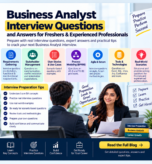
Business Analyst interview questions and answers for freshers and experienced professionals

Business Analyst Interview Questions and Answers for Freshers & Experienced Professionals

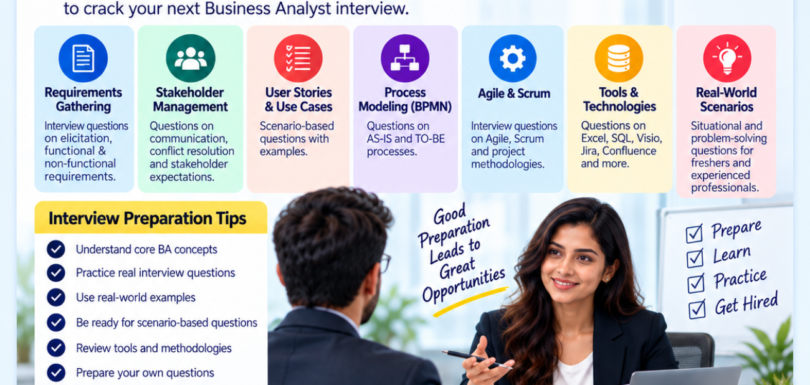
Preparing for a Business Analyst interview requires more than memorizing definitions. Employers may assess your understanding of requirements, business processes, stakeholder communication, problem-solving, Agile methodologies, and real-world Business Analysis scenarios. Whether you are a fresher preparing for your first Business Analyst interview or an experienced professional looking for your next opportunity, understanding common Business Analyst interview questions and answers can help you prepare more effectively. 1. What Does a Business Analyst Do? A Business Analyst helps an organization understand business problems, gather and analyze requirements, improve processes, and support effective solutions. A Business Analyst may work with stakeholders, project managers, developers, testers, product teams, and business users throughout a project. 2. What Is Requirements Elicitation? Requirements elicitation is the process of discovering and understanding the needs of stakeholders and users. Common techniques include: A Business Analyst may use multiple techniques depending on the project and stakeholders. 3. What Is the Difference Between Functional and Non-Functional Requirements? Functional requirements describe what a system should do. For example: The system should allow customers to reset their passwords. Non-functional requirements describe qualities or conditions under which the system should operate. For example: The password reset page should respond within a specified amount of time. Understanding both types of requirements is important when documenting a solution. 4. What Is a User Story? A user story describes a requirement from the perspective of a user. A common format is: As a [user], I want [function] so that [benefit]. For example: As a customer, I want to track my order so that I know when it will arrive. User stories are commonly used in Agile environments. 5. What Is a Use Case? A use case describes how an actor interacts with a system to achieve a specific goal. For example, a customer logging into an online banking system could be represented as a use case. A use case may include: 6. What Is BPMN? BPMN, or Business Process Model and Notation, is a standardized method for visually representing business processes. Business Analysts can use BPMN to document workflows, decisions, events, activities, and interactions between different participants. 7. What Is the Difference Between AS-IS and TO-BE Processes? The AS-IS process represents how a business process currently works. The TO-BE process represents the proposed future process after improvements or changes. Business Analysts can compare the two to identify process gaps and improvement opportunities. 8. How Do You Handle Conflicting Stakeholder Requirements? First, understand why the requirements conflict and identify the underlying business objectives. The Business Analyst can then: The approach may vary depending on the organization’s governance and project methodology. 9. What Business Analyst Tools Do You Know? Depending on the role, a Business Analyst may use tools such as: Candidates should focus on tools relevant to the specific job description and be prepared to explain how they have used them. 10. How Should Freshers Prepare for a Business Analyst Interview? Freshers should focus on understanding core Business Analysis concepts and practicing realistic scenarios. Build knowledge of: Practical projects can also help demonstrate your ability to apply these concepts. Business Analyst Interview Preparation Tips Before your interview: For experienced professionals, focus on explaining what you did, why you did it, how you handled challenges, and what the outcome was. Prepare for Your Business Analyst Career A strong Business Analyst career starts with strong fundamentals and practical skills. Learn Business Analysis. Build Business Solutions. Develop knowledge of requirements analysis, business processes, stakeholder management, use cases, user stories, process modeling, and practical Business Analysis through the Tech Learniversity Business Analyst Program. Prepare for Your Business Analyst Career
Read more
Top Business Analyst skills to learn in 2026

Top Business Analyst Skills You Need to Learn in 2026

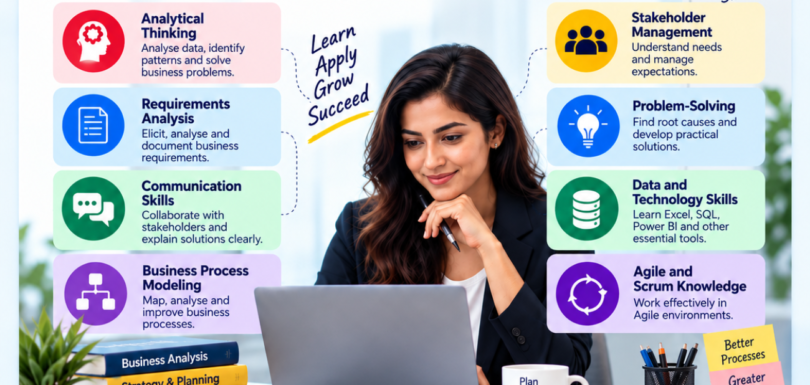
Business Analysts help organizations understand business problems, gather requirements, improve processes, and support effective solutions. As businesses continue to adopt digital technologies and data-driven processes, developing the right Business Analyst skills can help professionals prepare for opportunities across different industries. If you are planning to become a Business Analyst in 2026, this guide covers the top Business Analyst skills you should learn, from requirements analysis and communication to process modeling, data skills, and Agile methodologies. 1. Analytical Thinking Analytical thinking is one of the most important Business Analyst skills. Business Analysts need to break complex business problems into smaller components, examine available information, identify relationships, and understand potential solutions. Strong analytical thinking can help you move beyond identifying a problem to understanding its possible causes and business impact. 2. Requirements Elicitation Requirements elicitation involves discovering and understanding what stakeholders and users need from a proposed solution. Business Analysts may use: Learning how to ask the right questions and identify unclear requirements is essential for effective Business Analysis. 3. Requirements Analysis and Documentation After gathering requirements, Business Analysts need to analyze and document them clearly. Important areas include: Clear documentation helps business and technical teams develop a shared understanding of project expectations. 4. Communication Skills Business Analysts regularly communicate with both technical and non-technical stakeholders. You may need to explain business problems to developers, discuss requirements with managers, conduct stakeholder meetings, or present proposed solutions. Strong written and verbal communication can therefore be an important part of a Business Analyst’s professional toolkit. 5. Business Process Modeling Business Analysts often study how organizations currently perform tasks and identify opportunities for improvement. Useful techniques include: Understanding business processes allows analysts to identify bottlenecks, unnecessary steps, manual activities, and opportunities for improvement. 6. Stakeholder Management Different stakeholders can have different priorities. A Business Analyst needs to understand stakeholder expectations, communicate effectively, manage discussions, and help create a common understanding of project requirements. Stakeholder management is particularly important in projects involving multiple departments or user groups. 7. Problem-Solving and Root Cause Analysis Business Analysts should learn to investigate why a problem is happening, rather than focusing only on its symptoms. Techniques such as: can help structure problem-solving activities. 8. Data and Technology Skills Modern Business Analysts may work with business data and technology systems. Useful technical skills can include: The exact technical requirements depend on the Business Analyst role and organization. 9. Agile and Scrum Knowledge Many organizations use Agile approaches for software and product development. Business Analysts can benefit from understanding: Agile knowledge can help analysts collaborate more effectively with product and development teams. 10. Business and Industry Knowledge Understanding the business domain can help Business Analysts communicate more effectively and identify relevant solutions. Business Analysts can work in industries such as: Developing both Business Analysis skills and industry knowledge can strengthen your professional profile. How to Build Business Analyst Skills in 2026 The best way to develop Business Analyst skills is to combine structured learning with practical application. Study requirements, processes, stakeholder management, user stories, use cases, BPMN, Agile concepts, and relevant tools. Then apply those concepts through practical projects and realistic business scenarios. Start Building Your Business Analysis Skills Ready to develop the skills required for Business Analysis? Learn Business Analysis. Build Business Solutions. Develop practical knowledge of requirements, business processes, stakeholder management, use cases, user stories, process modeling, and other essential Business Analysis concepts through the Tech Learniversity Business Analyst Program. Master the Skills of a Business Analyst
Read more
Business Analyst vs Data Analyst roles skills tools and career differences

Business Analyst vs Data Analyst: Roles, Skills, Tools & Career Differences

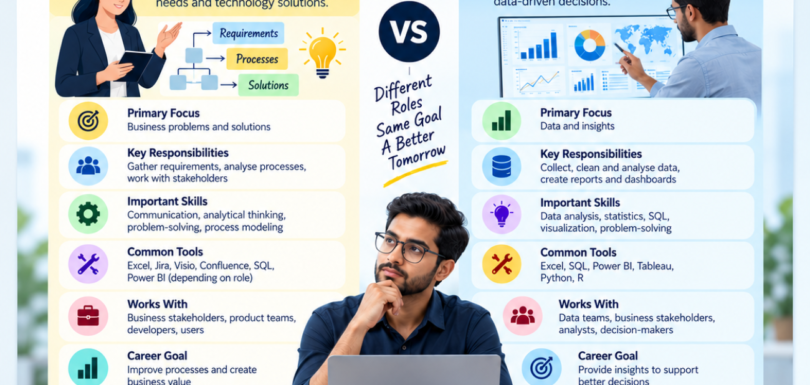
Business Analyst and Data Analyst are two popular career paths for people interested in business, technology, data, and problem-solving. Although these roles can overlap, their responsibilities, skills, tools, and primary areas of focus can be different. If you are deciding between a Business Analyst vs Data Analyst career, understanding these differences can help you identify the type of work that matches your interests and career goals. What Is a Business Analyst? A Business Analyst (BA) helps organizations understand business problems, gather requirements, analyze processes, and support practical solutions. Business Analysts often work with business stakeholders, customers, project teams, developers, and other professionals. Common Business Analyst responsibilities include: The Business Analyst role often focuses on understanding what the business needs and how a solution can address those needs. What Is a Data Analyst? A Data Analyst works primarily with data to identify patterns, generate insights, create reports, and support data-driven decision-making. Common Data Analyst responsibilities include: The Data Analyst role generally focuses more heavily on what the data shows and what insights can be obtained from it. Business Analyst vs Data Analyst: Key Differences Area Business Analyst Data Analyst Primary Focus Business problems and solutions Data and insights Requirements Core responsibility Supporting responsibility Process Analysis Important Sometimes relevant Data Analysis Useful Core responsibility Stakeholder Communication Very important Very important User Stories Common Less common Use Cases Common Less common SQL Useful depending on role Commonly used Power BI Useful Commonly used Business Process Modeling Important Less central Problem-Solving Core skill Core skill These responsibilities can vary significantly between companies, so job descriptions should always be reviewed carefully. Skills Required for a Business Analyst Important Business Analyst skills include: Knowledge of tools such as Excel, Jira, Visio, SQL, and Power BI can also be useful depending on the position. Skills Required for a Data Analyst Data Analysts commonly develop skills in: The specific technical requirements depend on the organization and role. Which Career Path Should You Choose? There is no single career path that is right for everyone. If you enjoy understanding business problems, working with stakeholders, gathering requirements, improving processes, and translating business needs into solutions, Business Analysis may align with your interests. If you enjoy working with datasets, analyzing numbers, creating dashboards, identifying trends, and generating data-driven insights, Data Analysis may be more aligned with your interests. You can also develop skills from both areas. Modern professionals may work with business requirements, data, dashboards, processes, and technology as part of the same project. Start Building Your Business Analysis Skills Interested in developing a Business Analyst skill set? Learn Business Analysis. Build Business Solutions. Build practical knowledge of requirements, stakeholder management, business processes, use cases, user stories, process modeling, and other essential Business Analysis concepts through the Tech Learniversity Business Analyst Program. Build Your Business Analysis Skills
Read more
How to become a Business Analyst in 2026 skills tools projects and career roadmap

How to Become a Business Analyst in 2026: Skills, Tools, Projects & Career Roadmap

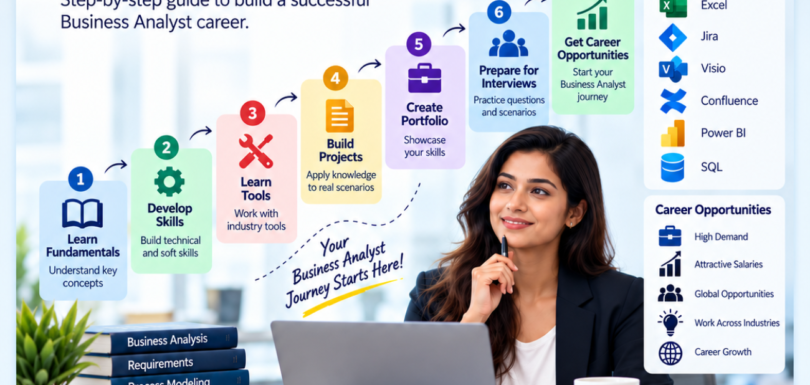
Business Analysts play an important role in helping organizations understand problems, improve processes, define requirements, and implement effective solutions. As businesses continue to adopt digital technologies, the ability to connect business needs with technology and practical solutions has become increasingly valuable. If you are wondering how to become a Business Analyst in 2026, this guide explains the essential skills, tools, projects, and career roadmap you can follow to start developing your Business Analyst career. What Does a Business Analyst Do? A Business Analyst (BA) helps organizations identify business problems, understand stakeholder needs, analyze requirements, and support solutions. Typical Business Analyst responsibilities include: The exact responsibilities vary depending on the organization, industry, and project. Step 1: Learn Business Analysis Fundamentals The first step toward becoming a Business Analyst is understanding the fundamentals. Learn concepts such as: A strong foundation makes it easier to apply Business Analysis techniques to real-world projects. Step 2: Develop Essential Business Analyst Skills Successful Business Analysts need a combination of analytical, communication, business, and technical skills. Important skills include: Analytical Thinking: Break complex problems into manageable components. Communication: Clearly communicate with business and technical stakeholders. Requirements Analysis: Understand, document, validate, and manage requirements. Problem-Solving: Identify the root cause of business problems and evaluate potential solutions. Process Modeling: Understand current workflows and design improved processes. Stakeholder Management: Work effectively with people who have different requirements and priorities. Data Literacy: Learn Excel, SQL, data analysis, and visualization tools such as Power BI where relevant to your role. Step 3: Learn Business Analyst Tools Business Analysts use different tools depending on their organization and project. Some commonly used tools include: You do not necessarily need to master every tool. Focus on tools that are relevant to the Business Analyst roles you want to pursue. Step 4: Build Practical Business Analyst Projects Practical projects can help you apply your knowledge and demonstrate your skills. For example, create a Business Analysis project for: Your project could include requirements, stakeholder analysis, user stories, use cases, process diagrams, AS-IS and TO-BE models, and solution recommendations. Step 5: Prepare for a Business Analyst Career Once you have developed your skills, create a professional resume and portfolio highlighting your projects, tools, and Business Analysis knowledge. Prepare for interviews by practicing questions related to requirements gathering, stakeholder management, process analysis, Agile, user stories, and real-world business scenarios. Business Analyst Career Roadmap A simple roadmap is: Learn Fundamentals → Develop Skills → Learn Tools → Build Projects → Create Portfolio → Prepare for Interviews → Apply for Opportunities Consistency and practical experience are important throughout this journey. Start Your Business Analysis Journey Ready to develop the skills needed to become a Business Analyst? Learn Business Analysis. Build Business Solutions. Explore Business Analysis concepts, tools, requirements, processes, and practical projects through the Tech Learniversity Business Analyst Program. Explore the Business Analyst Program
Read more

M Sendil Kumar

Tech Learniversity Blog

Meet M Sendil Kumar, Founder, Director & CEO of Tech Learniversity, leading our vision to make quality, technology-driven education accessible to learners worldwide.

Categories

Latest Posts

Tags

Subscribe Newsletter

Sign up to receive notifications about the latest news and events from us!

    x

    Contact With Us!

    13th Floor, 247 Park, Gandhi Nagar, Vikhroli West, Mumbai – 400079

    Mon – Sat: 9.00am – 23.00pm / Sunday/Holiday : Closed