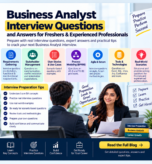


Preparing for a Business Analyst interview requires more than memorizing definitions. Employers may assess your understanding of requirements, business processes, stakeholder communication, problem-solving, Agile methodologies, and real-world Business Analysis scenarios.
Whether you are a fresher preparing for your first Business Analyst interview or an experienced professional looking for your next opportunity, understanding common Business Analyst interview questions and answers can help you prepare more effectively.
1. What Does a Business Analyst Do?
A Business Analyst helps an organization understand business problems, gather and analyze requirements, improve processes, and support effective solutions.
A Business Analyst may work with stakeholders, project managers, developers, testers, product teams, and business users throughout a project.
2. What Is Requirements Elicitation?
Requirements elicitation is the process of discovering and understanding the needs of stakeholders and users.
Common techniques include:
- Interviews
- Workshops
- Surveys
- Observation
- Brainstorming
- Document analysis
A Business Analyst may use multiple techniques depending on the project and stakeholders.
3. What Is the Difference Between Functional and Non-Functional Requirements?
Functional requirements describe what a system should do.
For example:
The system should allow customers to reset their passwords.
Non-functional requirements describe qualities or conditions under which the system should operate.
For example:
The password reset page should respond within a specified amount of time.
Understanding both types of requirements is important when documenting a solution.
4. What Is a User Story?
A user story describes a requirement from the perspective of a user.
A common format is:
As a [user], I want [function] so that [benefit].
For example:
As a customer, I want to track my order so that I know when it will arrive.
User stories are commonly used in Agile environments.
5. What Is a Use Case?
A use case describes how an actor interacts with a system to achieve a specific goal.
For example, a customer logging into an online banking system could be represented as a use case.
A use case may include:
- Actor
- Goal
- Preconditions
- Main flow
- Alternative flows
- Exceptions
- Postconditions
6. What Is BPMN?
BPMN, or Business Process Model and Notation, is a standardized method for visually representing business processes.
Business Analysts can use BPMN to document workflows, decisions, events, activities, and interactions between different participants.
7. What Is the Difference Between AS-IS and TO-BE Processes?
The AS-IS process represents how a business process currently works.
The TO-BE process represents the proposed future process after improvements or changes.
Business Analysts can compare the two to identify process gaps and improvement opportunities.
8. How Do You Handle Conflicting Stakeholder Requirements?
First, understand why the requirements conflict and identify the underlying business objectives.
The Business Analyst can then:
- Clarify the requirements.
- Identify business priorities.
- Analyze the impact of each requirement.
- Discuss alternatives with stakeholders.
- Document the agreed decision.
The approach may vary depending on the organization’s governance and project methodology.
9. What Business Analyst Tools Do You Know?
Depending on the role, a Business Analyst may use tools such as:
- Microsoft Excel
- Jira
- Confluence
- Microsoft Visio
- Lucidchart
- SQL
- Power BI
- Collaboration platforms
Candidates should focus on tools relevant to the specific job description and be prepared to explain how they have used them.
10. How Should Freshers Prepare for a Business Analyst Interview?
Freshers should focus on understanding core Business Analysis concepts and practicing realistic scenarios.
Build knowledge of:
- Requirements gathering
- Stakeholder analysis
- User stories
- Use cases
- Process modeling
- BPMN
- Agile concepts
- Root cause analysis
- Business documentation
Practical projects can also help demonstrate your ability to apply these concepts.
Business Analyst Interview Preparation Tips
Before your interview:
- Research the company and industry.
- Review the job description carefully.
- Prepare examples of projects you have worked on.
- Practice scenario-based questions.
- Review Business Analysis terminology.
- Prepare questions to ask the interviewer.
- Be ready to explain your problem-solving approach.
For experienced professionals, focus on explaining what you did, why you did it, how you handled challenges, and what the outcome was.
Prepare for Your Business Analyst Career
A strong Business Analyst career starts with strong fundamentals and practical skills.
Learn Business Analysis. Build Business Solutions.
Develop knowledge of requirements analysis, business processes, stakeholder management, use cases, user stories, process modeling, and practical Business Analysis through the Tech Learniversity Business Analyst Program.