
Global education data is highlighting a growing need for creativity, critical thinking, digital literacy and adaptability—not just academic knowledge.
For generations, education has focused on building strong foundations in reading, writing, mathematics, science and other academic subjects.
These foundations remain important.
But the world children are preparing to enter is changing rapidly.
Technology, artificial intelligence, automation, digital communication and changing workplace expectations are creating a new question for parents and educators:
Is knowing what to learn enough—or do children also need to learn how to think, create, solve problems and adapt?
Recent international evidence gives us some interesting insights.
1. Creative Thinking Is Now Being Measured Globally
In 2022, the OECD’s PISA assessment measured creative thinking for the first time among 15-year-old students across 64 countries and economies.
The assessment looked at students’ ability to generate, evaluate and improve original and diverse ideas across areas including written expression, visual expression, social problem-solving and scientific problem-solving.
The results were notable.
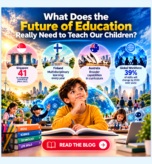
The OECD average score was 33 points, while Singapore recorded an average of 41 points. Finland recorded 36 points, and Australia recorded 37 points.
This does not mean that one education system can simply be copied by another.
But it does highlight something important:
Creativity can be treated as a capability worth developing and assessing—not simply as an extracurricular activity.
2. What Does This Tell Parents?
A child’s education cannot be reduced to examination marks alone.
Children will need knowledge.
But they will also need opportunities to:
- Ask questions
- Generate ideas
- Investigate problems
- Experiment
- Create
- Explain their thinking
- Work with others
- Learn from mistakes
- Apply knowledge to real situations
The important question therefore becomes:
How can education develop both academic foundations and the capabilities children may need to use those foundations effectively?
3. Finland Shows How Subjects Can Come Together
Finland provides another interesting example.
Its national core curriculum requires every school to conduct at least one multidisciplinary learning module each school year.
These modules combine content from different subjects around a theme, project or course, and students participate in planning them.
For example, a project about the environment could involve:
Science + Mathematics + Language + Technology + Communication
Instead of learning every subject as a completely separate experience, children can explore how different areas of knowledge connect.
The Finnish curriculum also emphasizes transversal competences such as thinking and learning to learn, cultural competence, interaction and self-expression, and managing daily life.
The lesson isn’t that every country should copy Finland.
The lesson is that education can connect knowledge with application.
4. Australia Includes More Than Traditional Academic Subjects
The Australian Curriculum provides another useful example.
Its current framework identifies seven general capabilities:
- Literacy
- Numeracy
- Critical and Creative Thinking
- Digital Literacy
- Personal and Social Capability
- Ethical Understanding
- Intercultural Understanding
These capabilities are developed through learning-area content rather than being treated simply as isolated subjects.
The curriculum also addresses AI through areas such as digital literacy, ethical understanding, critical and creative thinking, mathematics and digital technologies.
This reflects an increasingly important idea:
Children need knowledge—but they also need the ability to use knowledge responsibly in a digital world.
5. The World of Work Is Changing Too
The education question becomes even more interesting when we look at employment.
The World Economic Forum’s Future of Jobs Report 2025 found that employers expect 39% of workers’ existing core skills to change or become outdated between 2025 and 2030.
The report identifies analytical thinking as the most frequently identified core skill among employers.
It also highlights skills including:
- Resilience, flexibility and agility
- Leadership and social influence
- Creative thinking
- Motivation and self-awareness
- Technological literacy
- Curiosity and lifelong learning
- AI and big data
This does not mean that today’s academic subjects will become irrelevant.
Instead, it suggests that children may increasingly need to combine knowledge + thinking + technology + human skills.
So What Could Future-Ready Learning Look Like?
Imagine an education experience where a child doesn’t simply memorize information.
Instead, the child might:
Discover → Explore → Learn → Create → Apply → Solve → Share → Grow
A mathematics lesson could involve solving a real-world problem.
A science lesson could become an experiment.
A reading lesson could lead to discussion and storytelling.
A technology lesson could involve creating something.
A project could combine several subjects.
A family activity could become a learning opportunity.
And digital tools could be used not simply for entertainment, but for researching, creating, communicating and solving problems.
This Is Where Homeschooling Can Offer a Different Possibility
Homeschooling does not have to mean removing structure.
It can mean creating a more flexible learning environment around the child.
A family can combine:
Books + Online Lessons + Activities + Projects + Real-World Experiences + Parent Guidance
The parent does not necessarily need to become a professional teacher.
Instead, the parent can become a learning partner—helping the child ask questions, explore ideas, practise skills and connect learning to everyday life.
Of course, homeschooling is not automatically the right choice for every family. Different children and families have different circumstances, resources, schedules and educational requirements.
The important thing is to understand the available possibilities.
Introducing NeXGenX School
NeXGenX School is designed around the idea of future-ready learning for the next generation.
The goal is not to simply replace a classroom with a computer screen.
Instead, NeXGenX brings together:
📚 Physical Learning
Structured books and learning materials.
🎥 Online Learning
Video-based lessons that support learning at home.
🧠 Critical Thinking
Children are encouraged to question, analyse and reason.
🎨 Creativity
Opportunities to imagine, design, express and create.
🔬 Activities & Projects
Learning through doing—not only reading.
🌎 Real-World Learning
Connecting concepts with everyday experiences.
💡 Technology Awareness
Helping children understand the role of technology in modern life.
🤖 Age-Appropriate AI Awareness
Introducing AI concepts responsibly and appropriately as children grow.
❤️ Life Skills
Building practical capabilities alongside academic learning.
👨👩👧 Parent Partnership
Parents become part of the child’s learning journey.
The Bigger Question Isn’t “School or Homeschool?”
The more useful question may be:
What kind of learning environment will help my child develop the knowledge and capabilities they may need for the future?
Traditional schools can provide structure, teachers, peer interaction, facilities and established academic pathways.
Online learning can provide flexibility and access to digital resources.
Homeschooling can provide greater customization and opportunities to integrate learning into everyday life.
Hybrid approaches can combine elements of different models.
There is no single educational model that is universally appropriate for every child or family.
But the global evidence gives parents something worth thinking about.
Creative thinking is being measured.
Multidisciplinary learning is being incorporated into national curricula.
Digital literacy and critical thinking are explicit curriculum capabilities.
Employers expect significant changes in the skills workers will need.
So perhaps the future of education isn’t about choosing between old and new.
Perhaps it is about asking how we can combine strong academic foundations with the ability to think, create, communicate, adapt and apply knowledge.
Could Your Child’s Learning Journey Be Different?
At NeXGenX School, the vision is simple:
Learn at Home. Explore the World. Prepare for the Future.
A child’s education can be more than completing lessons.
It can become a journey of:
Discover → Explore → Learn → Create → Apply → Solve → Share → Grow
The future is difficult to predict.
But we can prepare children to become curious learners, thoughtful problem-solvers, creative thinkers and adaptable individuals.
Explore NeXGenX School
Discover a learning approach designed for the next generation.