
Business

Business Analyst vs Data Analyst roles skills tools and career differences

Business Analyst vs Data Analyst: Roles, Skills, Tools & Career Differences

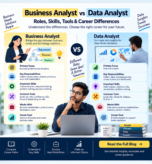
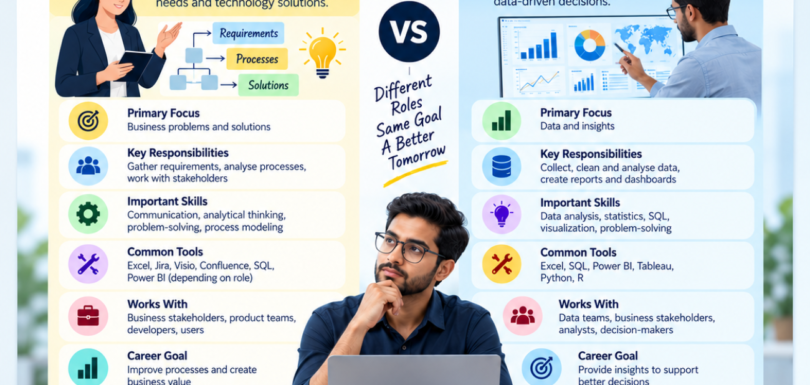
Business Analyst and Data Analyst are two popular career paths for people interested in business, technology, data, and problem-solving. Although these roles can overlap, their responsibilities, skills, tools, and primary areas of focus can be different. If you are deciding between a Business Analyst vs Data Analyst career, understanding these differences can help you identify the type of work that matches your interests and career goals. What Is a Business Analyst? A Business Analyst (BA) helps organizations understand business problems, gather requirements, analyze processes, and support practical solutions. Business Analysts often work with business stakeholders, customers, project teams, developers, and other professionals. Common Business Analyst responsibilities include: The Business Analyst role often focuses on understanding what the business needs and how a solution can address those needs. What Is a Data Analyst? A Data Analyst works primarily with data to identify patterns, generate insights, create reports, and support data-driven decision-making. Common Data Analyst responsibilities include: The Data Analyst role generally focuses more heavily on what the data shows and what insights can be obtained from it. Business Analyst vs Data Analyst: Key Differences Area Business Analyst Data Analyst Primary Focus Business problems and solutions Data and insights Requirements Core responsibility Supporting responsibility Process Analysis Important Sometimes relevant Data Analysis Useful Core responsibility Stakeholder Communication Very important Very important User Stories Common Less common Use Cases Common Less common SQL Useful depending on role Commonly used Power BI Useful Commonly used Business Process Modeling Important Less central Problem-Solving Core skill Core skill These responsibilities can vary significantly between companies, so job descriptions should always be reviewed carefully. Skills Required for a Business Analyst Important Business Analyst skills include: Knowledge of tools such as Excel, Jira, Visio, SQL, and Power BI can also be useful depending on the position. Skills Required for a Data Analyst Data Analysts commonly develop skills in: The specific technical requirements depend on the organization and role. Which Career Path Should You Choose? There is no single career path that is right for everyone. If you enjoy understanding business problems, working with stakeholders, gathering requirements, improving processes, and translating business needs into solutions, Business Analysis may align with your interests. If you enjoy working with datasets, analyzing numbers, creating dashboards, identifying trends, and generating data-driven insights, Data Analysis may be more aligned with your interests. You can also develop skills from both areas. Modern professionals may work with business requirements, data, dashboards, processes, and technology as part of the same project. Start Building Your Business Analysis Skills Interested in developing a Business Analyst skill set? Learn Business Analysis. Build Business Solutions. Build practical knowledge of requirements, stakeholder management, business processes, use cases, user stories, process modeling, and other essential Business Analysis concepts through the Tech Learniversity Business Analyst Program. Build Your Business Analysis Skills

Read more
How to become a Business Analyst in 2026 skills tools projects and career roadmap

How to Become a Business Analyst in 2026: Skills, Tools, Projects & Career Roadmap

Business Analysts play an important role in helping organizations understand problems, improve processes, define requirements, and implement effective solutions. As businesses continue to adopt digital technologies, the ability to connect business needs with technology and practical solutions has become increasingly valuable. If you are wondering how to become a Business Analyst in 2026, this guide explains the essential skills, tools, projects, and career roadmap you can follow to start developing your Business Analyst career. What Does a Business Analyst Do? A Business Analyst (BA) helps organizations identify business problems, understand stakeholder needs, analyze requirements, and support solutions. Typical Business Analyst responsibilities include: The exact responsibilities vary depending on the organization, industry, and project. Step 1: Learn Business Analysis Fundamentals The first step toward becoming a Business Analyst is understanding the fundamentals. Learn concepts such as: A strong foundation makes it easier to apply Business Analysis techniques to real-world projects. Step 2: Develop Essential Business Analyst Skills Successful Business Analysts need a combination of analytical, communication, business, and technical skills. Important skills include: Analytical Thinking: Break complex problems into manageable components. Communication: Clearly communicate with business and technical stakeholders. Requirements Analysis: Understand, document, validate, and manage requirements. Problem-Solving: Identify the root cause of business problems and evaluate potential solutions. Process Modeling: Understand current workflows and design improved processes. Stakeholder Management: Work effectively with people who have different requirements and priorities. Data Literacy: Learn Excel, SQL, data analysis, and visualization tools such as Power BI where relevant to your role. Step 3: Learn Business Analyst Tools Business Analysts use different tools depending on their organization and project. Some commonly used tools include: You do not necessarily need to master every tool. Focus on tools that are relevant to the Business Analyst roles you want to pursue. Step 4: Build Practical Business Analyst Projects Practical projects can help you apply your knowledge and demonstrate your skills. For example, create a Business Analysis project for: Your project could include requirements, stakeholder analysis, user stories, use cases, process diagrams, AS-IS and TO-BE models, and solution recommendations. Step 5: Prepare for a Business Analyst Career Once you have developed your skills, create a professional resume and portfolio highlighting your projects, tools, and Business Analysis knowledge. Prepare for interviews by practicing questions related to requirements gathering, stakeholder management, process analysis, Agile, user stories, and real-world business scenarios. Business Analyst Career Roadmap A simple roadmap is: Learn Fundamentals → Develop Skills → Learn Tools → Build Projects → Create Portfolio → Prepare for Interviews → Apply for Opportunities Consistency and practical experience are important throughout this journey. Start Your Business Analysis Journey Ready to develop the skills needed to become a Business Analyst? Learn Business Analysis. Build Business Solutions. Explore Business Analysis concepts, tools, requirements, processes, and practical projects through the Tech Learniversity Business Analyst Program. Explore the Business Analyst Program
Read more
What is a Business Analyst career guide for beginners in 2026

What Is a Business Analyst? Complete Career Guide for Beginners in 2026

Businesses today rely on technology, data, and efficient processes to improve performance and serve customers better. But how does a company identify its problems and determine what solution it actually needs? This is where a Business Analyst plays an important role. If you are wondering what a Business Analyst does, what skills you need, and how to become a Business Analyst in 2026, this beginner-friendly guide will help you understand the career path. What Is a Business Analyst? A Business Analyst (BA) is a professional who helps organizations understand business problems, identify requirements, analyze processes, and support effective solutions. Business Analysts often work between business stakeholders and technical teams. They help translate business needs into clear requirements that development, technology, product, and project teams can understand. For example, if a company wants to develop a new customer management system, a Business Analyst may speak with stakeholders, understand their requirements, analyze the existing process, document requirements, create use cases or user stories, and support the team throughout the project. In simple terms: Business Analyst = Business Problems + Requirements + Analysis + Solutions What Does a Business Analyst Do? The responsibilities of a Business Analyst can vary depending on the organization and industry. Common responsibilities include: A Business Analyst may also use techniques such as BPMN, process mapping, root cause analysis, SWOT analysis, and requirements elicitation. Essential Business Analyst Skills in 2026 To build a successful Business Analyst career, you need a combination of business, analytical, technical, and communication skills. Important skills include: Analytical Thinking: Understanding complex problems and identifying potential solutions. Requirements Analysis: Gathering, documenting, validating, and managing business requirements. Communication: Explaining requirements clearly to stakeholders and technical teams. Business Process Modeling: Understanding current processes and designing improved workflows. Problem-Solving: Identifying the root cause of business problems. Data Skills: Knowledge of Excel, SQL, data visualization, and tools such as Power BI can be useful depending on the role. Agile Knowledge: Understanding user stories, acceptance criteria, sprints, and other Agile concepts can help Business Analysts work effectively with modern project teams. How to Become a Business Analyst in 2026 If you are starting your Business Analyst career, begin with the fundamentals of Business Analysis. Learn requirements gathering, stakeholder management, process modeling, use cases, user stories, and documentation. You can then develop practical knowledge of tools such as Excel, SQL, Power BI, Jira, Visio, and other business analysis tools depending on your career goals. Most importantly, practice with real-world projects. Creating sample business requirements, process diagrams, user stories, and solution documentation can help you demonstrate practical skills to potential employers. Is Business Analysis a Good Career for Beginners? Business Analysis can be a suitable career path for people who enjoy problem-solving, communication, business processes, technology, and working with stakeholders. Professionals can work across industries such as IT, banking, healthcare, retail, logistics, education, insurance, and many others. Career progression may include roles such as Business Analyst, Senior Business Analyst, Lead Business Analyst, Business Analysis Manager, Product Manager, or Consultant, depending on experience and career goals. Start Your Business Analysis Journey Want to develop the skills needed to work as a Business Analyst? Learn Business Analysis. Build Business Solutions. Explore practical Business Analysis concepts, requirements, processes, tools, and projects with the Tech Learniversity Business Analyst Program. Explore the Business Analyst Program
Read more

M Sendil Kumar

Tech Learniversity Blog

Meet M Sendil Kumar, Founder, Director & CEO of Tech Learniversity, leading our vision to make quality, technology-driven education accessible to learners worldwide.

Categories

Latest Posts

Tags

Subscribe Newsletter

Sign up to receive notifications about the latest news and events from us!

    x

    Contact With Us!

    13th Floor, 247 Park, Gandhi Nagar, Vikhroli West, Mumbai – 400079

    Mon – Sat: 9.00am – 23.00pm / Sunday/Holiday : Closed