
How to Become an AI & Machine Learning Engineer in 2027: Skills, Tools & Career Roadmap
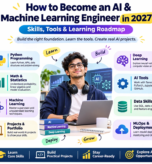
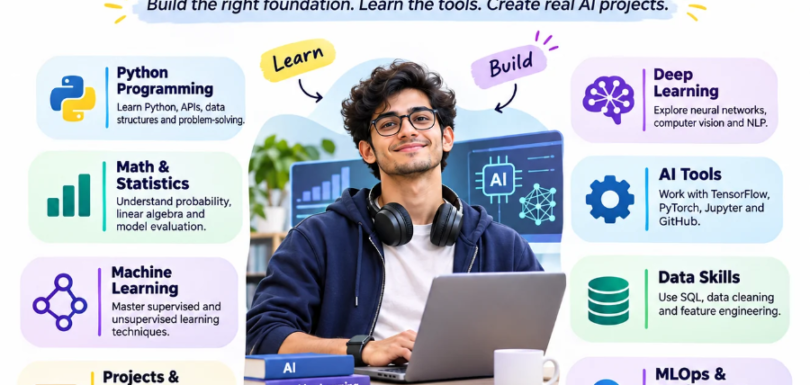
Artificial Intelligence (AI) and Machine Learning (ML) are transforming industries, from healthcare and finance to e-commerce, manufacturing and software development. According to the World Economic Forum’s Future of Jobs Report 2025, AI and Machine Learning Specialists are among the fastest-growing technology roles projected through 2030. If you’re planning to build a career in this field, understanding the right learning pathway is essential. This AI and Machine Learning Engineer Roadmap for 2027 explains the skills, programming languages, technologies and projects needed to get started. What Does an AI & Machine Learning Engineer Do? AI and Machine Learning Engineers design, develop, evaluate and deploy intelligent systems that learn from data or use AI models to perform tasks. Key responsibilities include: Step-by-Step AI & Machine Learning Engineer Roadmap for 2027 Step 1: Learn Python Programming Python is one of the most widely used programming languages for AI and Machine Learning development. Essential Python skills: Practice project: Build a Python application that analyzes student performance data. Step 2: Understand Mathematics and Statistics Mathematics provides the foundation for understanding how Machine Learning algorithms operate. Important concepts include: Beginners can learn mathematical concepts alongside practical programming exercises. Step 3: Master Machine Learning Fundamentals Machine Learning enables systems to identify patterns and make predictions using data. Core topics: Important library: Scikit-learn. Practice project: Build a customer churn prediction model. Step 4: Learn Deep Learning and Neural Networks Deep Learning uses multilayer neural networks to learn complex patterns. Essential topics: Popular frameworks: TensorFlow, Keras and PyTorch. Practice project: Develop an image classification application. Step 5: Explore Generative AI and Large Language Models Generative AI enables applications to generate text, images and other content. Key skills include: Practice project: Build a document-based AI question-answering assistant. Step 6: Learn MLOps and Model Deployment MLOps helps developers deploy, maintain and monitor Machine Learning systems. Important technologies: Learn responsible AI practices, including data privacy, bias assessment and model reliability. Step 7: Build Real-World AI & ML Projects A practical portfolio demonstrates your ability to apply AI concepts. Recommended projects: Document your approach, datasets, evaluation methods, limitations and project results. Can Beginners Learn AI and Machine Learning? Yes. Students, non-IT graduates and working professionals can begin learning AI and ML. However, advanced engineering roles usually require substantial programming, mathematics and practical development skills. Start with Python and fundamental statistics before progressing to advanced models and deployment. AI & Machine Learning Career Opportunities Depending on skills and experience, learners can explore: Entry-level opportunities vary by employer, and completing a training course does not guarantee employment. Start Your AI & ML Career with Tech Learniversity Tech Learniversity offers Artificial Intelligence & Machine Learning Professional Training, designed to help learners develop AI knowledge through structured instruction and practical learning. Explore Python programming, Machine Learning, Deep Learning, AI applications and project-based learning. Build your AI capabilities and prepare for the next generation of technology opportunities. Explore Our Artificial Intelligence & Machine Learning Professional Training Program Website: https://techlearniversity.com/