

Software development continues to evolve as businesses invest in web applications, enterprise platforms and digital services.
Full Stack Java Development combines frontend technologies, backend programming, database management and application deployment.
Java remains an important language for enterprise application development. Combined with Spring Boot, React and SQL, it provides a practical technology stack for building modern web applications.
If you’re planning to become a Full Stack Java Developer, this 2027 career roadmap explains the essential skills, technologies and projects to learn.
What Does a Full Stack Java Developer Do?
A Full Stack Java Developer builds and maintains both the frontend and backend components of web applications.
Key responsibilities include:
- Developing responsive user interfaces.
- Building backend applications using Java.
- Creating RESTful APIs.
- Integrating databases.
- Implementing authentication and authorization.
- Testing, debugging and deploying applications.
- Collaborating with software development teams.
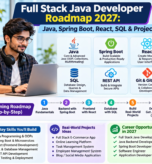
Step-by-Step Full Stack Java Developer Roadmap for 2027
Step 1: Master Core Java Programming
Core Java provides the foundation for backend application development.
Essential Java concepts:
- Variables, operators and control statements
- Object-Oriented Programming (OOP)
- Classes, objects and inheritance
- Exception handling
- Collections Framework
- Multithreading fundamentals
- Java Streams and Lambda Expressions
Learn a supported Java Long-Term Support (LTS) version, such as Java 21 or Java 25, depending on your project requirements.
Practice project: Develop a Student Management System using Core Java.
Step 2: Learn HTML, CSS and JavaScript
Frontend development focuses on creating interfaces that users interact with.
Important technologies:
- HTML5 and semantic elements
- CSS3 and responsive design
- JavaScript fundamentals
- DOM manipulation
- ES6+ features
- Asynchronous JavaScript
- Fetch API
Practice project: Build a responsive personal portfolio website.
Step 3: Develop Frontend Applications Using React
React is a popular JavaScript library for creating component-based user interfaces.
Essential React skills:
- Components and JSX
- Props and state
- React Hooks
- Event handling
- Forms and validation
- API integration
- Client-side routing
Practice project: Create an Employee Management Dashboard using React.
Step 4: Master Spring Boot and Backend Development
Spring Boot simplifies the development of Java-based backend applications.
Important topics:
- Spring Framework fundamentals
- Dependency Injection
- Spring Boot architecture
- REST API development
- Spring Data JPA
- Hibernate ORM
- Exception handling
- Spring Security fundamentals
Practice project: Develop REST APIs for an online shopping application.
Step 5: Learn SQL and Database Integration
Databases store and manage application information.
Essential database skills:
- Relational database concepts
- SQL queries and joins
- Database normalization
- Primary and foreign keys
- CRUD operations
- JDBC and JPA
- Database integration using Spring Boot
Practice project: Connect an Employee Management Application to MySQL or PostgreSQL.
Step 6: Learn Git, Testing and Application Deployment
Professional developers need version control, testing and deployment skills.
Important tools and concepts:
- Git and GitHub
- Maven or Gradle
- JUnit and Mockito
- Postman for API testing
- Docker fundamentals
- CI/CD basics
- Cloud deployment fundamentals
Practice deploying a complete Java web application.
Step 7: Build Real-World Full Stack Java Projects
Projects demonstrate your ability to integrate frontend, backend and database technologies.
Recommended portfolio projects:
- E-commerce Website with Product Management
- Employee Management System
- Online Banking Application Prototype
- Hospital Appointment Booking System
- Learning Management System (LMS)
Include authentication, database integration, API development and responsive interfaces where appropriate.
Can Beginners Learn Full Stack Java Development?
Yes. Students, fresh graduates and professionals from non-programming backgrounds can start learning Full Stack Java Development.
Begin with programming fundamentals before progressing to Spring Boot, React and database integration.
Consistent coding practice and portfolio development are essential for building professional skills.
Full Stack Java Developer Career Opportunities
Depending on technical skills and experience, learners can explore:
- Junior Java Developer
- Java Backend Developer
- Full Stack Java Developer
- Spring Boot Developer
- Software Developer
- Web Application Developer
Career advancement may lead toward Senior Software Developer, Technical Lead or Software Architect positions.
Start Your Full Stack Java Developer Career with Tech Learniversity
Tech Learniversity offers a Full Stack Java Developer Professional Training Program designed to help learners develop software development skills through structured learning and practical projects.
Build foundational knowledge in Java programming, frontend development, backend technologies, databases and application development.
Develop practical coding skills and take the next step toward your software development career.
Explore Our Full Stack Java Developer Professional Training Program
Website: https://techlearniversity.com/