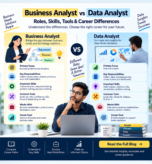


Business Analyst and Data Analyst are two popular career paths for people interested in business, technology, data, and problem-solving. Although these roles can overlap, their responsibilities, skills, tools, and primary areas of focus can be different.
If you are deciding between a Business Analyst vs Data Analyst career, understanding these differences can help you identify the type of work that matches your interests and career goals.
What Is a Business Analyst?
A Business Analyst (BA) helps organizations understand business problems, gather requirements, analyze processes, and support practical solutions.
Business Analysts often work with business stakeholders, customers, project teams, developers, and other professionals.
Common Business Analyst responsibilities include:
- Gathering business requirements
- Conducting requirements elicitation
- Analyzing business processes
- Creating use cases and user stories
- Developing AS-IS and TO-BE process models
- Communicating with stakeholders
- Supporting solution evaluation
- Identifying process improvement opportunities
The Business Analyst role often focuses on understanding what the business needs and how a solution can address those needs.
What Is a Data Analyst?
A Data Analyst works primarily with data to identify patterns, generate insights, create reports, and support data-driven decision-making.
Common Data Analyst responsibilities include:
- Collecting and preparing data
- Cleaning data
- Analyzing datasets
- Creating reports and dashboards
- Identifying trends and patterns
- Developing KPIs and visualizations
- Communicating data insights
- Supporting business decisions with data
The Data Analyst role generally focuses more heavily on what the data shows and what insights can be obtained from it.
Business Analyst vs Data Analyst: Key Differences
| Area | Business Analyst | Data Analyst |
|---|---|---|
| Primary Focus | Business problems and solutions | Data and insights |
| Requirements | Core responsibility | Supporting responsibility |
| Process Analysis | Important | Sometimes relevant |
| Data Analysis | Useful | Core responsibility |
| Stakeholder Communication | Very important | Very important |
| User Stories | Common | Less common |
| Use Cases | Common | Less common |
| SQL | Useful depending on role | Commonly used |
| Power BI | Useful | Commonly used |
| Business Process Modeling | Important | Less central |
| Problem-Solving | Core skill | Core skill |
These responsibilities can vary significantly between companies, so job descriptions should always be reviewed carefully.
Skills Required for a Business Analyst
Important Business Analyst skills include:
- Analytical thinking
- Requirements analysis
- Requirements elicitation
- Stakeholder management
- Communication
- Business process modeling
- Problem-solving
- Documentation
- User stories and use cases
- Agile concepts
Knowledge of tools such as Excel, Jira, Visio, SQL, and Power BI can also be useful depending on the position.
Skills Required for a Data Analyst
Data Analysts commonly develop skills in:
- Data analysis
- Excel
- SQL
- Statistics
- Data visualization
- Power BI or Tableau
- Python or R
- Data cleaning
- Reporting
- Analytical thinking
The specific technical requirements depend on the organization and role.
Which Career Path Should You Choose?
There is no single career path that is right for everyone.
If you enjoy understanding business problems, working with stakeholders, gathering requirements, improving processes, and translating business needs into solutions, Business Analysis may align with your interests.
If you enjoy working with datasets, analyzing numbers, creating dashboards, identifying trends, and generating data-driven insights, Data Analysis may be more aligned with your interests.
You can also develop skills from both areas. Modern professionals may work with business requirements, data, dashboards, processes, and technology as part of the same project.
Start Building Your Business Analysis Skills
Interested in developing a Business Analyst skill set?
Learn Business Analysis. Build Business Solutions.
Build practical knowledge of requirements, stakeholder management, business processes, use cases, user stories, process modeling, and other essential Business Analysis concepts through the Tech Learniversity Business Analyst Program.