

Technology is transforming industries, creating new career opportunities and changing the skills employers expect. As artificial intelligence, automation, cloud computing and data-driven decision-making become increasingly important, professionals need practical technical knowledge to remain competitive.
According to the World Economic Forum’s Future of Jobs Report 2025, AI and big data, cybersecurity and technological literacy are among the fastest-growing skills expected through 2030.
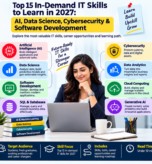
Whether you’re a student, fresher, working professional or career changer, here are 15 valuable IT skills to consider learning in 2027.
1. Artificial Intelligence (AI)
Artificial Intelligence enables machines to perform tasks involving prediction, reasoning and decision-making. Learning Python, AI fundamentals and intelligent applications can prepare learners for emerging AI-related opportunities.
Career paths: AI Developer, AI Engineer, AI Solutions Specialist.
2. Machine Learning (ML)
Machine Learning helps systems identify patterns in data and make predictions. Essential topics include supervised learning, model evaluation, feature engineering and Scikit-learn.
Career paths: Machine Learning Engineer, ML Developer.
3. Data Science
Data Science combines programming, statistics and analytical techniques to extract insights from complex datasets.
Key skills: Python, Pandas, NumPy, statistics, predictive modeling and data visualization.
Career paths: Data Scientist, Junior Data Scientist.
4. Data Analytics
Organizations rely on data analysts to monitor performance, identify trends and support business decisions.
Key skills: Microsoft Excel, SQL, Python, Power BI and dashboard development.
Career paths: Data Analyst, Reporting Analyst.
5. Business Analysis
Business Analysts connect business requirements with technology solutions. They identify problems, document requirements and support process improvements.
Key skills: Requirements gathering, Agile, Scrum, Jira, BRD, FRD and stakeholder communication.
Career paths: Business Analyst, IT Business Analyst.
6. Business Intelligence (BI)
Business Intelligence transforms business data into dashboards, reports and actionable insights.
Key skills: Power BI, SQL, ETL, data modeling, DAX and data warehousing.
Career paths: BI Developer, Business Intelligence Analyst.
7. Cybersecurity
Cybersecurity protects networks, applications and sensitive information against digital threats.
Key skills: Network security, ethical hacking fundamentals, vulnerability assessment, SIEM and incident response.
Career paths: SOC Analyst, Cybersecurity Analyst.
8. Cloud Computing
Cloud platforms enable businesses to deploy applications, store information and manage computing resources.
Key technologies: Microsoft Azure, AWS, Google Cloud, virtualization and cloud security.
Career paths: Cloud Support Engineer, Cloud Engineer.
9. Full Stack Java Development
Java remains an important technology for enterprise applications and backend systems.
Key skills: Core Java, Spring Boot, REST APIs, SQL and frontend integration.
Career paths: Java Developer, Full Stack Java Developer.
10. Full Stack Python Development
Python supports web applications, backend services, automation and integration with AI technologies.
Key skills: Python, Django, FastAPI, JavaScript, databases and REST APIs.
Career paths: Python Developer, Backend Developer.
11. Full Stack Web Development
Full Stack Web Developers build user interfaces, server-side applications and database-driven platforms.
Key skills: HTML, CSS, JavaScript, React, Node.js and databases.
Career paths: Web Developer, Full Stack Developer.
12. SQL & Database Development
SQL helps professionals retrieve, manipulate and manage structured business data.
Key skills: Microsoft SQL Server, T-SQL, joins, stored procedures, indexing and query optimization.
Career paths: SQL Developer, Database Developer.
13. DevOps & Automation
DevOps combines software development, operations and automation to improve application delivery.
Key technologies: Git, Docker, Kubernetes, Jenkins and CI/CD pipelines.
Career paths: DevOps Engineer, Automation Engineer.
14. Generative AI & AI Automation
Generative AI enables content generation, intelligent assistants and workflow automation.
Key skills: Prompt engineering, large language models, AI APIs, retrieval-augmented generation and AI agents.
Career paths: Generative AI Developer, AI Automation Specialist.
15. Data Engineering
Data Engineering focuses on designing reliable data pipelines and preparing information for analytics and AI applications.
Key skills: SQL, Python, ETL, data pipelines, cloud data platforms and data warehouses.
Career paths: Data Engineer, ETL Developer.
How to Choose the Right IT Skill in 2027
Choose your learning path based on your interests and career goals:
- Business and problem-solving: Business Analysis.
- Data and dashboards: Data Analytics, Power BI or Business Intelligence.
- AI and predictive modeling: Data Science or Machine Learning.
- Programming and applications: Java, Python or Full Stack Web Development.
- Security and infrastructure: Cybersecurity or Cloud Computing.
Start with fundamentals, practice consistently, build real-world projects and create a portfolio demonstrating your skills.
Build Future-Ready IT Skills with Tech Learniversity
Tech Learniversity offers live instructor-led IT training programs designed to develop practical technical knowledge through structured learning, guided exercises and real-world applications.
Explore our programs in Business Analysis, Data Analytics, Data Science, AI & Machine Learning, Cybersecurity, Power BI, SQL Server and Full Stack Development.
Your next career opportunity begins with the skills you develop today.
Explore Tech Learniversity’s Professional Training Programs: https://techlearniversity.com/