

Businesses generate enormous amounts of data every day. However, raw data becomes valuable only when organizations can transform it into meaningful insights.
This is where Business Intelligence (BI) Developers play an important role.
BI Developers design data solutions, develop reporting systems and create dashboards that help organizations make informed decisions.
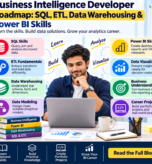
If you’re planning to enter the data industry, this Business Intelligence Developer Roadmap for 2027 explains the essential skills, technologies and practical projects needed to build your career.
What Does a Business Intelligence Developer Do?
A Business Intelligence Developer transforms data from multiple sources into structured information that supports business reporting and decision-making.
Key responsibilities include:
- Designing and maintaining BI solutions.
- Developing SQL queries and database objects.
- Building ETL data integration pipelines.
- Creating data warehouses and analytical models.
- Developing Power BI dashboards and reports.
- Improving data accuracy and reporting performance.
- Collaborating with business stakeholders.
Step-by-Step Business Intelligence Developer Roadmap for 2027
Step 1: Master SQL and Database Fundamentals
SQL is a foundational skill for Business Intelligence development.
Essential SQL skills:
- SELECT, WHERE, GROUP BY and HAVING
- INNER JOIN, LEFT JOIN and subqueries
- Common Table Expressions (CTEs)
- Window functions
- Stored procedures and views
- Query optimization and indexing
Practice project: Analyze retail transactions using Microsoft SQL Server to identify revenue trends and product performance.
Step 2: Understand Data Warehousing
Data warehouses consolidate information from multiple business systems for reporting and analysis.
Important concepts include:
- Relational database fundamentals
- OLTP vs OLAP
- Fact and dimension tables
- Star and snowflake schemas
- Data warehouse architecture
- Slowly Changing Dimensions (SCD)
Practice project: Design a retail sales data warehouse containing customer, product, date and transaction information.
Step 3: Learn ETL and Data Integration
ETL stands for Extract, Transform and Load. It prepares information from different sources for analysis.
Key ETL skills:
- Data extraction and transformation
- Data cleaning and validation
- SQL Server Integration Services (SSIS)
- ETL workflow development
- Error handling and logging
- Data quality monitoring
Modern BI environments may also use cloud-based data integration platforms.
Practice project: Build an ETL pipeline that integrates sales information from CSV files and SQL databases.
Step 4: Develop Microsoft Power BI Skills
Power BI enables BI Developers to build interactive reports and data visualization solutions.
Essential Power BI topics:
- Power BI Desktop and Power Query
- Data transformation
- Semantic modeling and relationships
- DAX measures and calculations
- Interactive dashboards
- Row-Level Security (RLS)
- Report publishing and refresh
Practice project: Develop an executive sales performance dashboard featuring revenue, profitability and regional trends.
Step 5: Learn Advanced Data Modeling and DAX
Advanced modeling improves analytical accuracy and report performance.
Focus on:
- Star schema modeling
- Filter context and relationships
- CALCULATE and iterator functions
- Time intelligence calculations
- Year-over-year comparisons
- Model and report optimization
Practice project: Create a financial dashboard displaying monthly revenue, budget variance and profitability.
Step 6: Explore Cloud BI and Microsoft Fabric
Modern Business Intelligence increasingly involves cloud-based analytics platforms.
Useful technologies to explore include:
- Microsoft Azure
- Azure Data Factory
- Microsoft Fabric
- OneLake
- Cloud data warehouses
- Data pipeline orchestration
Learn these concepts after developing strong SQL, ETL and Power BI fundamentals.
Step 7: Build a Business Intelligence Portfolio
Practical projects demonstrate your ability to develop complete BI solutions.
Recommended portfolio projects:
- Retail Sales Analytics Dashboard
- HR Workforce Analytics Solution
- Financial Performance Reporting System
- Supply Chain Analytics Dashboard
- End-to-End SQL, ETL and Power BI Project
Document the business problem, data architecture, transformations, visualizations and business insights for each project.
Can Beginners Become Business Intelligence Developers?
Yes. Fresh graduates, Data Analysts, SQL learners and career changers can begin learning Business Intelligence.
Start with SQL and database fundamentals before progressing to ETL, data modeling, Power BI and practical projects.
Technical proficiency develops through consistent hands-on practice.
Business Intelligence Developer Career Opportunities
Depending on qualifications and experience, learners can explore:
- Junior BI Developer
- Business Intelligence Developer
- Power BI Developer
- ETL Developer
- Reporting Developer
- BI Analyst
Experience may support progression toward Senior BI Developer, BI Architect or Analytics Engineering roles.
Start Your BI Developer Career with Tech Learniversity
Tech Learniversity’s Business Intelligence Developer Professional Training Program is designed to help learners build practical Business Intelligence knowledge through structured training and hands-on projects.
Develop skills in SQL, data warehousing, ETL, Power BI, data modeling and business reporting.
Turn business data into actionable insights and take your next step toward a Business Intelligence career.
Explore Our Business Intelligence Developer Training Program
Website: https://techlearniversity.com/