

Data is transforming how businesses make decisions. Organizations use data analytics to understand customers, improve operations, monitor performance and identify growth opportunities.
As businesses increasingly adopt data-driven strategies, learning Data Analytics can open opportunities across industries, including finance, healthcare, retail, technology and e-commerce.
But how can beginners start a Data Analyst career?
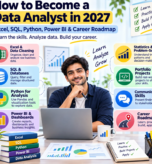
This step-by-step Data Analyst Roadmap for 2027 explains the essential skills, tools, projects and career preparation needed to enter the field.
What Does a Data Analyst Do?
A Data Analyst collects, cleans, processes and interprets data to identify patterns and support business decisions.
Key responsibilities include:
- Collecting and validating business data.
- Cleaning incomplete or inconsistent datasets.
- Analyzing trends and performance metrics.
- Writing SQL queries to retrieve information.
- Creating interactive dashboards and reports.
- Communicating findings to stakeholders.
Data Analysts help organizations transform raw information into meaningful business insights.
Step-by-Step Data Analyst Roadmap for 2027
Step 1: Learn Microsoft Excel for Data Analysis
Excel is an excellent starting point for beginners because it introduces data organization, calculations and reporting.
Essential Excel skills:
- Formulas and functions
- VLOOKUP, XLOOKUP and INDEX-MATCH
- PivotTables and PivotCharts
- Data cleaning and validation
- Conditional formatting
- Power Query fundamentals
Practice project: Create a retail sales dashboard showing revenue, product performance and monthly sales trends.
Step 2: Master SQL for Data Analytics
SQL is essential for retrieving and analyzing information stored in relational databases.
Important SQL concepts:
- SELECT, WHERE and ORDER BY
- GROUP BY and HAVING
- INNER JOIN and LEFT JOIN
- Subqueries and Common Table Expressions
- Window functions
- Data aggregation and reporting
Practice project: Analyze customer orders to identify best-selling products and repeat customers.
Step 3: Learn Python for Data Analysis
Python helps analysts automate repetitive tasks, clean datasets and perform advanced analysis.
Key Python topics:
- Variables, loops and functions
- Pandas and NumPy
- Data cleaning and transformation
- Exploratory Data Analysis (EDA)
- Matplotlib and Seaborn
- Basic statistical analysis
Practice project: Analyze customer purchasing patterns using Python.
Step 4: Develop Power BI Dashboard Skills
Microsoft Power BI enables analysts to transform data into interactive reports and business dashboards.
Essential Power BI skills:
Practice project: Develop an HR analytics dashboard analyzing employee turnover, attendance and department performance.
- Data importing and transformation
- Power Query
- Data modeling and relationships
- DAX calculations
- Interactive visualizations
- Dashboard storytelling
Step 5: Understand Statistics and Business Analytics
Statistics provides the foundation for interpreting data accurately.
Focus on:
- Mean, median and mode
- Probability fundamentals
- Standard deviation
- Correlation and regression
- Hypothesis testing
- Key Performance Indicators (KPIs)
Understanding business objectives is equally important because meaningful analysis must answer real business questions.
Step 6: Build a Professional Data Analyst Portfolio
A strong portfolio demonstrates practical analytical capabilities.
Recommended portfolio projects:
- Retail Sales Performance Dashboard
- Customer Segmentation Analysis
- HR Attrition Analytics
- Financial Revenue Analysis
- E-commerce Customer Behavior Analysis
Include project objectives, datasets, methodology, dashboards and actionable insights.
Publish suitable projects on GitHub or a professional portfolio website.
Step 7: Prepare for Data Analyst Interviews
Practice technical and scenario-based interview questions covering:
- SQL joins and aggregations
- Excel functions and PivotTables
- Python Pandas operations
- Power BI data modeling and DAX
- Data cleaning techniques
- Business problem-solving
Learn to explain your findings clearly to both technical and non-technical audiences.
Can You Become a Data Analyst Without an IT Background?
Yes. Graduates from commerce, arts, finance, management and other disciplines can begin learning Data Analytics.
Advanced programming knowledge is not required to start. However, consistent practice and demonstrable analytical skills are important when applying for jobs.
Data Analyst Career Opportunities in 2027
Depending on skills and experience, learners can explore roles such as:
- Junior Data Analyst
- Data Analyst
- Reporting Analyst
- MIS Analyst
- Business Data Analyst
- Power BI Analyst
Career progression may lead toward senior analytics, Business Intelligence or Data Science positions.
Start Your Data Analyst Journey with Tech Learniversity
Tech Learniversity’s Data Analyst Professional Training Program helps learners build practical data analytics skills through structured learning and hands-on exercises.
Develop knowledge of Excel, SQL, Python, Power BI, data visualization and real-world business analytics.
Transform data into insights and take the next step toward your analytics career.
Explore Our Data Analyst Professional Training Program
Website: https://techlearniversity.com/