

Technology is becoming an essential part of everyday life, and coding is increasingly valuable for developing creativity, logical thinking and problem-solving skills. Many parents wonder: What is the best age for kids to start learning Python programming?
The answer depends on a child’s interests, reading ability and readiness to understand basic instructions.
Python is a beginner-friendly programming language that helps children progress from simple coding exercises to interactive games and real-world applications.
Let’s explore when children can start learning Python and how parents can support their coding journey.
What Is Python Programming for Kids?
Python is a widely used programming language known for its readable syntax and versatility.
Children can use Python to create:
- Interactive games and quizzes
- Mathematical calculators
- Simple animations and drawings
- Storytelling applications
- Educational mini-projects
- Basic automation programs
Unlike some programming languages, Python allows beginners to focus on understanding programming concepts without dealing with unnecessarily complex syntax.
What Is the Best Age to Start Learning Python?
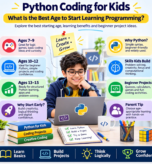
There is no universally correct age to begin programming. However, different age groups benefit from different learning approaches.
Ages 5–7: Introduction to Coding Concepts
Young children can explore programming through visual, block-based activities.
Recommended activities:
- Sequencing and pattern recognition
- Logic-based puzzles
- ScratchJr and visual coding games
- Basic computational thinking
At this stage, playful learning is generally more suitable than intensive text-based programming.
Ages 8–9: Transition Toward Programming
Children can begin understanding conditions, repetition and simple algorithms through Scratch or beginner-friendly Python exercises.
Short, engaging activities help build confidence before progressing to larger programs.
Ages 10–12: An Excellent Starting Point for Python
Many children aged 10 and above are ready to explore structured Python programming with appropriate guidance.
They can begin learning:
- Variables and data types
- Input and output statements
- Conditional statements
- Loops
- Functions
- Lists and basic data structures
- Simple Python projects
For many beginners, ages 10–12 offer a practical starting point for text-based Python coding.
Ages 13–16: Building Real Applications
Teenagers can progress toward advanced programming concepts, including:
- Object-oriented programming
- File handling
- Error handling
- Graphical user interfaces
- Game development
- Application development
These skills help learners transition from coding exercises to independently developed projects.
7 Benefits of Learning Python Coding for Kids
1. Develops Logical Thinking
Coding teaches children to break complex challenges into smaller, manageable steps.
2. Strengthens Problem-Solving
Debugging programs encourages experimentation, patience and systematic thinking.
3. Encourages Creativity
Children can transform their ideas into games, quizzes, stories and interactive applications.
4. Introduces Computational Thinking
Programming familiarizes students with algorithms, patterns, sequencing and abstraction.
5. Builds Digital Confidence
Understanding how software works helps children become more confident technology users and creators.
6. Supports Mathematics and Analytical Skills
Python projects can provide practical opportunities to explore arithmetic, coordinates, logic and data.
7. Creates a Foundation for Future Technology Learning
Python introduces concepts relevant to software development, data science, artificial intelligence and automation.
5 Beginner-Friendly Python Projects for Kids
Children can reinforce their learning through enjoyable practical activities.
- Number Guessing Game: Practice loops, conditions and user input.
- Simple Calculator: Explore variables, operators and functions.
- Interactive Quiz: Develop conditional logic and scoring systems.
- Turtle Graphics Art: Create drawings using commands, colors and loops.
- Rock-Paper-Scissors Game: Combine decision-making and random selections.
These projects help children understand programming by building something they can demonstrate and improve.
How Can Parents Help Children Learn Python?
Parents do not need programming expertise to encourage coding.
Support your child’s learning by:
- Choosing age-appropriate lessons.
- Encouraging hands-on projects.
- Providing opportunities to practice.
- Celebrating creativity rather than perfection.
- Allowing children to learn from mistakes.
- Maintaining a healthy balance between screen time and other activities.
Structured guidance and constructive feedback can make the learning experience more engaging.
Learn Python with Tech Learniversity’s NeXGenX School
NeXGenX School — Coding for Kids, an initiative by Tech Learniversity, offers a progressive learning pathway for children interested in programming.
Level 1: Python Programming Essentials for Kids
Designed to introduce beginners to Python fundamentals, logical thinking and practical coding exercises.
Learning areas: Variables, data types, loops, conditions, functions and beginner-friendly projects.
Level 2: Advanced Python Programming for Kids
Designed for learners who understand Python fundamentals and want to develop more sophisticated programming skills.
Learning areas: Object-oriented programming, file handling, application development and advanced projects.
Both levels focus on helping children progress through structured learning and practical application.
Give Your Child a Head Start in Coding
Programming is not only about preparing for future technology careers. It can also help children become creative thinkers, confident problem-solvers and active creators of digital solutions.
Start your child’s Python coding journey with Tech Learniversity’s NeXGenX School.
Explore our beginner and advanced Python programming programs for kids.
Learn More About NeXGenX School