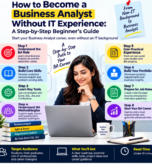


Want to start a career in IT but don’t have a technical background? Becoming a Business Analyst (BA) could be an excellent career option.
Business Analysts help organizations identify business problems, gather requirements, improve processes and develop effective solutions. The role combines analytical thinking, communication and business knowledge rather than requiring advanced programming expertise.
Whether you’re a fresher, non-IT graduate or working professional planning a career transition, this guide explains how to become a Business Analyst without IT experience.
What Does a Business Analyst Do?
A Business Analyst acts as a bridge between business stakeholders and technical teams, ensuring business needs are understood and translated into actionable requirements.
Key responsibilities include:
- Understanding business challenges and objectives.
- Gathering and documenting stakeholder requirements.
- Preparing Business Requirements Documents (BRD) and Functional Requirements Documents (FRD).
- Analyzing workflows and recommending improvements.
- Collaborating with developers, testers and project managers.
- Supporting User Acceptance Testing (UAT).
Can You Become a Business Analyst Without IT Experience?
Yes! You can begin learning Business Analysis without a programming background or previous IT employment.
Graduates from commerce, arts, management, finance and other disciplines can pursue this career by developing relevant technical and professional skills.
However, securing an entry-level position requires practical knowledge, demonstrable projects and interview preparation.
Step-by-Step Business Analyst Career Roadmap for 2027
Step 1: Understand Business Analysis Fundamentals
Begin by understanding:
- Business Analysis Body of Knowledge (BABOK)
- Software Development Life Cycle (SDLC)
- Agile and Waterfall methodologies
- Requirements elicitation and analysis
- Stakeholder management
- Business process improvement
These fundamentals establish a foundation for more advanced Business Analysis responsibilities.
Step 2: Develop Essential Business Analyst Skills
Successful Business Analysts combine technical understanding with interpersonal skills.
Important skills include:
- Analytical thinking and problem-solving
- Requirements gathering and documentation
- Effective business communication
- Process mapping using BPMN and UML
- User stories and acceptance criteria
- Agile Scrum fundamentals
- Data analysis and reporting
Focus on applying these skills through realistic business scenarios.
Step 3: Learn Popular Business Analyst Tools
Familiarity with industry-relevant tools improves your ability to contribute to projects.
| Tool | Primary purpose |
|---|---|
| Microsoft Excel | Data analysis and reporting |
| SQL | Database queries and data retrieval |
| Power BI | Dashboards and visualization |
| Jira | Agile project and issue tracking |
| Confluence | Documentation and collaboration |
| Visio / Draw.io | Process mapping and flowcharts |
You don’t need advanced expertise in every tool initially. Start with the fundamentals and gradually develop practical proficiency.
Step 4: Build Real-World Business Analyst Projects
Practical projects demonstrate your ability to apply theoretical concepts.
Beginner-friendly project ideas:
- E-commerce website requirements analysis.
- Banking loan application workflow improvement.
- Hospital appointment management system.
- Retail sales reporting and dashboard development.
For each project, prepare sample requirements, user stories, process diagrams and relevant documentation.
Organize your completed work into a professional portfolio.
Step 5: Consider Business Analyst Certification
Professional certifications can help demonstrate foundational knowledge.
The Entry Certificate in Business Analysis (ECBA) from the International Institute of Business Analysis (IIBA) is designed for individuals beginning their Business Analysis careers.
It does not require previous Business Analysis work experience. Certification is optional, and completing a training course does not automatically provide an IIBA credential.
Step 6: Prepare for Business Analyst Interviews
Practice questions covering:
- Functional vs non-functional requirements
- BRD vs FRD vs SRS
- Agile vs Waterfall
- User stories and acceptance criteria
- Stakeholder conflict management
- SQL fundamentals
- Scenario-based requirements gathering
Mock interviews, project explanations and communication practice can improve your interview readiness.
Step 7: Apply for Entry-Level Business Analyst Roles
Explore opportunities such as:
- Junior Business Analyst
- Associate Business Analyst
- Business Analysis Intern
- Requirements Analyst
- Business Process Analyst
Tailor your resume to highlight transferable skills, practical projects, documentation expertise and problem-solving abilities.
How Long Does It Take to Learn Business Analysis?
Learning time varies based on your background, study schedule and practical experience.
A structured learning program can help beginners progress from basic concepts to projects and interview preparation. Becoming job-ready may require additional independent practice beyond classroom training.
Start Your Business Analyst Career with Tech Learniversity
Tech Learniversity offers Business Analyst Professional Training — Beginner to Advanced, designed for learners seeking structured, practical Business Analysis education.
Program highlights:
- 230 hours of live instructor-led training
- 20 comprehensive modules
- 4 guided practical projects
- 20 hours of career preparation
- Business Analysis fundamentals through advanced concepts
- Hands-on exposure to SQL, Power BI, Jira and Agile methodologies
Develop your Business Analysis knowledge, strengthen your practical skills and prepare for opportunities across different industries.
Take the first step toward your Business Analyst career.
Explore Our Business Analyst Professional Training Program
Website: https://techlearniversity.com/