

Business Intelligence Developer Program
Transform your career with Tech Learniversity’s Business Intelligence Developer Program—gain the skills to design, develop, and deploy impactful BI solutions for data-driven decisions.
- Home Main
- Business Intelligence Developer Program
Course Details
From: Tech Learniversity
Start Day: Coming Soon
Project Duration: 120 Hours
Get in Touch with Tech Learniversity
Call us directly or email us!
Address Business
Hindustan C. Bus Stop,
Lal Bahadur Shastri Rd,
Gandhi Nagar, Vikhroli West,
Mumbai - 400079,
Maharashtra, India
Contact With Us
HR: (+91) 70217 89240
business@techlearniversity.com
hr@techlearniversity.com
Working Time
Holiday : Closed

Business Intelligence Developer Program
This Business Intelligence Developer Program focuses on the end-to-end lifecycle of designing, developing, and maintaining BI solutions. Participants gain comprehensive knowledge of databases, ETL/ELT processes, data modeling, cloud-based technologies, and interactive reporting tools. By completing this program, learners will be able to translate business needs into effective data-driven solutions that power strategic decision-making.
Course Overview
The role of a Business Intelligence (BI) Developer is critical for leveraging organizational data to generate insights. The program delves into:
– SQL Proficiency: Advanced query writing, joins, subqueries, common table expressions (CTEs), and window functions.
– Data Warehousing: OLAP vs. OLTP, Kimball and Inmon methodologies, dimensional modeling, indexing, and schema design.
– ETL/ELT Tools: Microsoft SSIS, Azure Data Factory, AWS Glue, Python scripts, and API integrations for data manipulation.
– Data Visualization & Reporting: Power BI, Tableau, SSRS, and principles of effective dashboard creation.
– Advanced Analytics & Cloud: Cubes with SSAS, orchestration tools, and an introduction to big data processing with Spark/Hadoop.
– Soft Skills & Project Best Practices: Requirements gathering, communication, agile methodologies, and version control.
– Capstone Project: An end-to-end BI solution, from data ingestion to interactive dashboards.
Course Type
This program is designed for a beginner-to-intermediate audience. It gradually introduces fundamental concepts before moving into advanced BI tools and development techniques, making it appropriate for newcomers while also offering depth for those with some data background.
Course Objectives
1. Master RDBMS & SQL: Develop an in-depth understanding of relational database concepts, complex joins, indexing, window functions, and best practices for performance tuning.
2. Learn ETL/ELT Methods: Use mainstream tools (SSIS, Azure Data Factory, AWS Glue) to build reliable data pipelines, from ingestion and staging to transformation and loading.
3. Build Data Warehouses: Implement dimensional modeling, star/snowflake schemas, and handle slowly changing dimensions.
4. Leverage Python for Automation: Employ Python scripting (NumPy, Pandas) for data manipulation and advanced transformations.
5. Implement BI & Analytics: Create dashboards and reports using Power BI, Tableau, and SSRS. Gain exposure to OLAP cubes, SSAS, and basic data science integrations.
6. Adopt Cloud Solutions: Explore cloud-based data warehousing platforms (Snowflake, Azure Synapse, AWS Redshift) and orchestration tools for large-scale analytics.
7. Practice Good Governance & Security: Understand data governance, role-based access control, and data lineage to ensure secure, accurate reporting.
8. Develop Soft Skills & Agile Mindsets: Communicate effectively with business stakeholders, manage agile sprints, and use version control to streamline collaboration.
Duration
120 Hours
Requirements
– A computer (Windows / macOS / Linux) with at least 8 GB of RAM and sufficient storage.
– Internet access for cloud-based exercises, collaboration, and tool installations.
– Willingness to install and configure databases (SQL Server, PostgreSQL, or MySQL) and BI tools (Power BI, Tableau Public, SSIS, etc.).
Pre-requisites
– Basic understanding of databases and spreadsheets is helpful but not mandatory.
– No prior programming or BI experience required—this course ramps up from foundational to advanced topics.
Target Audience
– Aspiring BI Developers from both technical and non-technical backgrounds.
– Database professionals expanding into reporting, data warehousing, or ETL.
– Data Analysts looking to deepen knowledge of BI pipelines and architecture.
– IT managers or professionals seeking an integrated view of data management and analytics.
– Recent graduates with an interest in data-centric careers.
Career and Future Prospects
Graduates can explore roles such as:
– Business Intelligence (BI) Developer
– Data Warehouse Developer
– ETL Developer
– BI Analyst / Consultant
– Data Engineer (with additional specialization)
– Cloud Data Solutions Engineer
As data continues to drive business decisions, skilled BI Developers can grow into senior development roles, solutions architecture, or BI management positions, often commanding strong salary growth and leadership opportunities.
Designation/Title
Common job titles for those completing this program include:
– Junior BI Developer
– BI Developer
– Senior BI Developer
– BI Architect
– Data Warehouse Engineer
– Cloud BI Engineer
Projects
Projects are embedded throughout each module, culminating in a comprehensive capstone:
1. SQL & DBMS Project
– Build and optimize a relational database using advanced SQL constructs (window functions, indexing).
– Use T-SQL / PL/SQL / PostgreSQL queries to manipulate test data.
2. ETL/ELT Pipeline Development
– Develop a data integration workflow with SSIS or Azure Data Factory.
– Implement error handling, logging, and schedule the pipeline to run automatically.
3. Data Warehouse & Modeling
– Implement dimensional modeling using star/snowflake schemas.
– Create fact and dimension tables, handle slowly changing dimensions.
4. Python for Data Processing
– Leverage Pandas for data cleaning and transformation.
– Automate tasks with Python scripts (e.g., reading APIs, merging datasets).
5. Reporting & Dashboard
– Design an interactive dashboard in Power BI or Tableau.
– Incorporate calculated fields/measures (DAX in Power BI, LOD in Tableau).
6. Capstone Project
– An end-to-end BI solution: ingest data from multiple sources, store it in a data warehouse, clean/transform it, and develop a real-time or scheduled dashboard.
– Present final insights to a mock executive team or technical audience.
Salary
₹6 LPA – ₹15 LPA
$70,000 – $110,000
CA$65,000 – CA$100,000
£35,000 – £60,000
AU$75,000 – AU$110,000
Features
– Hands-On Curriculum: Engage with real tools like SSIS, Power BI, Tableau, and Python for robust BI solutions.
– Cloud Integration: Explore Azure, AWS, or GCP for modern, scalable analytics.
– Industry Best Practices: Adopt dimensional modeling, agile sprints, version control, and data security measures.
– Portfolio-Building Projects: Each module includes practical tasks leading to a final capstone solution.
– Career Support: Resume/CV guidance, interview preparation, and mentorship for BI-focused roles.
Benefits
– End-to-End BI Mastery: Gain skills in data warehousing, ETL, and interactive reporting.
– Technical & Soft Skills: Combine coding, database design, data visualization, and stakeholder communication.
– Real-World Relevance: Learn methods and tools widely used in top tech and data-centric organizations.
– Professional Network: Collaborate with peers, instructors, and potential employers within a supportive environment.
– Enhanced Career Prospects: Position yourself for roles in data engineering, advanced analytics, or BI architecture.
The Results
Empowered Decision-Making: By integrating data from disparate sources into cohesive dashboards, organizations often see a notable uptick in data-driven culture.
Reduced Overhead & Complexity: A well-structured data architecture and robust ETL processes can reduce maintenance costs and manual reporting tasks.
Career Upgrades: Graduates have a comprehensive skill set that aligns with high-demand BI roles, often leading to salary jumps or promotions.
Actionable Insights: Deploying interactive dashboards and analytical solutions means leadership can act swiftly on real-time metrics, fueling growth and innovation.
Batch Details
Batch Start Date:
Batch End Date:
Batch Timings:
Batch Days:
Next Batch
Batch Start Date:
Batch End Date:
Batch Timings:
Batch Days:
Next Batch
Curriculum
SQL Mastery:
Advanced T-SQL (SQL Server),
PL/SQL (Oracle), or PostgreSQL;
Complex joins
Understanding Joins:
Purpose of joins in relational databases
Types of relationships: One-to-One, One-to-Many, Many-to-Many
SQL Join Types:
INNER JOIN: Most common, returns matching rows
LEFT (OUTER) JOIN: Returns all rows from left table, matches from right
RIGHT (OUTER) JOIN: Returns all rows from right table, matches from left
FULL (OUTER) JOIN: Returns all rows when there is a match in either table
SELF JOIN: Joining a table to itself
CROSS JOIN: Cartesian product
Join Conditions:
ON clause vs. USING clause
Multiple join conditions
Subqueries
Scalar subqueries: Returning a single value
Row subqueries: Returning a single row
Table subqueries: Returning a table (used with IN, EXISTS, ANY, ALL)
Correlated subqueries: Dependent on outer query
CTEs
WITH clause for readability and complex queries
Recursive CTEs for hierarchical data (e.g., organizational charts),
Window Functions
ROW_NUMBER(), RANK(), DENSE_RANK(), NTILE()
LEAD(), LAG(), FIRST_VALUE(), LAST_VALUE()
Aggregate window functions (SUM() OVER(…), AVG() OVER(…))
Relational Database (RDBMS) Concepts:
Data, Information, Database, DBMS, RDBMS
Key concepts: Tables, Rows (Records), Columns (Fields), Primary Keys, Foreign Keys, Relationships (One-to-One, One-to-Many, Many-to-Many)
SQL standards (ANSI SQL-92, SQL:1999, SQL:2003, SQL:2008, SQL:2011, SQL:2016)
Schema design (normalization/denormalization)
Benefits of normalization (data integrity, reduced redundancy)
Denormalization strategies for performance
Indexing strategies (clustered, non-clustered)
When to use indexes, types of indexes
Impact on read/write performance
Covering indexes, composite indexes
Data Warehousing (DW) Concepts: OLAP vs. OLTP; Kimball vs. Inmon methodologies; dimensional modeling (facts, dimensions, measures, hierarchies).
Data Governance & Security: Data quality principles (accuracy, completeness, consistency), data lineage, role-based access control (RBAC).
Data Integration (ETL/ELT):
ETL Tools: Proficiency in Microsoft SSIS (SQL Server Integration Services) for package creation, deployment, and scheduling; error handling, logging.
Cloud ETL/ELT: Azure Data Factory, AWS Glue, Google Cloud Dataflow for scalable cloud-native data pipelines.
Scripting:
Python for data manipulation (Pandas, NumPy)
Introduction to NumPy:
What is NumPy? The core library for numerical operations (e.g., C-optimized arrays for speed)
NumPy arrays (ndarray): Creation, indexing, slicing, reshaping
Array operations: Element-wise operations, broadcasting rules
Advanced NumPy:
Linear algebra operations (e.g., dot product, matrix multiplication, inverse)
Statistical functions (e.g., mean, median, standard deviation on arrays)
Random number generation (e.g., np.random.rand, np.random.randint)
Introduction to Pandas:
What is Pandas? The foundational library for data structures (e.g., Series, DataFrame)
Creating DataFrames and Series: From dictionaries, lists, NumPy arrays
Importing and exporting data: pd.read_csv, pd.read_excel, df.to_csv
Data Inspection and Cleaning:
Viewing data: df.head(), df.info(), df.describe(), df.shape
Handling missing data: df.isnull(), df.dropna(), df.fillna()
Data type conversion: df.astype(), pd.to_datetime
Removing duplicates: df.drop_duplicates()
Data Selection and Filtering:
Column selection: df[‘column’], df[[‘col1’, ‘col2’]]
Row selection: df.loc, df.iloc
Conditional filtering: Boolean indexing (e.g., df[df[‘age’] > 30])
Data Transformation:
Applying functions: df.apply(), df.map(), df.transform()
Grouping and aggregation: df.groupby(), agg() (e.g., df.groupby(‘category’)[‘value’].mean())
Merging and joining DataFrames: pd.merge(), pd.concat() (e.g., inner, outer, left, right joins)
Pivoting and melting data: df.pivot_table(), pd.melt()
Automation scripts, API integrations.
Data Loading Techniques: Full load, incremental load strategies; change data capture (CDC) mechanisms.
Data Modeling & Storage:
Dimensional Modeling: Star schema, snowflake schema implementation; slowly changing dimensions (SCD Type 1, 2, 3).
Data Lake/Lakehouse Concepts: Understanding Parquet, ORC, Delta Lake formats; structured vs. unstructured data storage.
Cloud Data Warehouses: Snowflake, Azure Synapse Analytics, AWS Redshift, Google BigQuery for large-scale analytics.
Reporting Tools: Power BI Desktop and Service (DAX, M-query, direct query, import mode), Tableau Desktop and Server (calculated fields, LOD expressions), SSRS (report builder, report server deployment).
Dashboard Design: Principles of effective data visualization (Tufte, Few); UX/UI for clear insights; storytelling with data.
Ad-hoc Reporting: Empowering business users with self-service BI capabilities via tools like Power BI or Tableau.
Analytical Processing (OLAP): Building cubes with SQL Server Analysis Services (SSAS) – Tabular and Multidimensional models; MDX queries.
Data Pipeline Orchestration: Using Airflow, Azure DevOps, or similar tools for end-to-end workflow management.
Performance Tuning: Optimizing SQL queries, ETL packages, and dashboard load times; understanding query plans, indexing.
Big Data Fundamentals: Introduction to Spark, Hadoop, NoSQL databases (MongoDB, Cassandra) for handling massive datasets.
Introduction to Data Science/Machine Learning: Basic understanding of statistical analysis, predictive modeling concepts, integration with BI tools (e.g., Python scripts in Power BI).
Communication: Translating technical concepts for non-technical stakeholders; gathering requirements effectively.
Problem-Solving: Debugging complex data issues; analytical thinking to solve business challenges.
Agile Methodologies: Participating in sprint planning, daily stand-ups, backlog grooming for BI projects.
Version Control: Using Git/Azure DevOps Repos for code management and collaboration.
Case Studies: Analyzing and designing BI solutions for specific industries (e.g., retail sales, healthcare operations, financial reporting).
Capstone Project: Developing a complete BI solution from data source to interactive dashboard using acquired skills.
Project Definition:
Choosing a dataset (e.g., Kaggle, UCI ML Repository)
Defining problem statement and objectives
Data Analysis Workflow:
End-to-end application of learned skills: data loading, cleaning, EDA, visualization, feature engineering, model building, evaluation, and interpretation
Presentation and Communication:
Preparing a Jupyter Notebook report
Summarizing findings and insights
Discussing limitations and future work
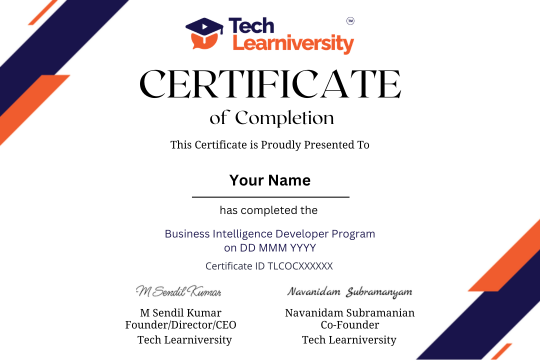
Certification of Completion
Tech Learniversity is proud to uphold ISO 9001:2015 Certified Quality Management System standards, reflecting our strong commitment to excellence and continual improvement. By adhering to globally recognized best practices, we deliver courses and services with consistent quality, reliability, and transparency.
Our QMS framework ensures that every training module—whether in Business Intelligence Developer Program—follows meticulous processes for development, review, and learner support.
Ultimately, this certification demonstrates our pledge to meet and exceed the expectations of students and industry partners, cultivating trust and long-term success in all our educational offerings.

Quality Education from Quality People
Choose Tech Learniversity for quality education from industry experts committed to empowering your success. Embark on a transformative educational journey with Tech Learniversity and unlock your potential for a brighter future. Together, we can create meaningful experiences that inspire growth, collaboration, and success!
Exceptional Student Satisfaction
Impressive Job Placement Success
Diverse Course Offerings
Global Reach
“

What Our Students Say?
More than 99% students satisfaction is our success.
Oscar Frimpong
Fiorella Reynoso Donzelli
joe riah

Billy Oscar
Course Questions
Explore common questions about the course.
What types of courses does Tech Learniversity offer?
How do I enroll in a course?
Are there any prerequisites for the courses?
What is the duration of the courses?
Do you offer job placement assistance?
Can I attend workshops and events?
Is financial aid available?
How can I contact Tech Learniversity for further questions?
What is the learning format of the courses?
How do I provide feedback on my learning experience?
Services Questions
Lorem ipsum dolor sit amet, consectetur adipiscing elit. Proin tincidunt tellus
What skills will I gain from the bootcamp?
How does the job guarantee program work?
What types of career-enhancing courses do you offer?
What is included in the Career Pro X program?
How does the Elevate X program benefit my professional growth?
What is the format of the Engage X program?
What certifications can I prepare for through your courses?
What educational resources do you provide for school students?
How can Tech Learniversity support college students?
What types of courses are available for university students?
What specialized training does your institute offer?
How can Tech Learniversity assist corporate training needs?
What types of workshops can I expect?
How does the customized 1 to 1 training work?
What is included in the customized group training programs?
What does the interview preparation course entail?
Didn’t Find the Answer? Ask us Questions
Call us directly or email us!
Address Business
Hindustan C. Bus Stop,
Lal Bahadur Shastri Rd,
Gandhi Nagar, Vikhroli West,
Mumbai - 400079,
Maharashtra, India
Contact With Us
HR: (+91) 70217 89240
business@techlearniversity.com
hr@techlearniversity.com
Working Time
Holiday : Closed
Frequently Asked Questions
What skills will I learn in Tech Learniversity’s Business Intelligence Developer Program?
How does this program help non-IT professionals transition into a BI Developer role?
What types of projects will I work on during the BI Developer Program?
What career support does Tech Learniversity provide upon completion?

Get in Touch with Tech Learniversity!
Build Your Career with Tech Learniversity!
Address Business
Hindustan C. Bus Stop,
Lal Bahadur Shastri Rd,
Gandhi Nagar, Vikhroli West,
Mumbai - 400079,
Maharashtra, India
Contact With Us
Email Address
hr@techlearniversity.com
Working Time
Sunday/Holiday : Closed