

Artificial Intelligence & Machine Learning Developer Program
Master Artificial Intelligence and Machine Learning from beginner to advanced topics through 180 hours of instructor-led training in Python, statistics, predictive modeling, Deep Learning, Generative AI, LLMs and RAG, supported by practical labs and an industry-oriented capstone project.
Course Details
From: Tech Learniversity
Start Day: Coming Soon
Project Duration: 180 Hours
Get in Touch with Tech Learniversity
Call us directly or email us!
Address Business
Hindustan C. Bus Stop,
Lal Bahadur Shastri Rd,
Gandhi Nagar, Vikhroli West,
Mumbai - 400079,
Maharashtra, India
Contact With Us
HR: (+91) 70217 89240
business@techlearniversity.com
hr@techlearniversity.com
Working Time
Holiday : Closed

Artificial Intelligence & Machine Learning Developer Program
Develop practical Artificial Intelligence and Machine Learning skills with Tech Learniversity’s 180-hour AI & ML Developer Program, designed to take beginners from programming and data fundamentals to building intelligent applications and predictive models.
Learn Python, NumPy, Pandas, SQL fundamentals, statistics, supervised and unsupervised Machine Learning, model evaluation, Deep Learning, Natural Language Processing, Computer Vision, Generative AI, Large Language Models and Retrieval-Augmented Generation through structured, instructor-led training.
Gain hands-on experience developing Machine Learning models, analyzing data, evaluating AI applications and creating working prototypes using Python, scikit-learn, TensorFlow/Keras, Hugging Face, FastAPI and other relevant tools, culminating in a supervised 22-hour capstone project and professional technical portfolio.
Course Type
Mode: Online Live Instructor-led Training
Duration
180 Hours
Course Level
Beginner to Advanced
Requirements
Hardware Requirements
- Laptop or desktop computer.
- Windows, macOS or Linux operating system.
- Minimum 8 GB RAM recommended for introductory Python and data analysis.
- 16 GB RAM preferred for local Machine Learning and development work.
- Modern multi-core processor.
- Adequate storage for Python environments, datasets and project files.
- Stable broadband internet connection.
- Headphones and microphone for online classes.
GPU Requirements
A dedicated GPU is not mandatory for every learner.
Selected Deep Learning and Computer Vision activities may benefit from GPU-enabled computing. Suitable hosted notebooks, pretrained models or smaller datasets can be used when local hardware is insufficient.
Software and Development Tools
The recommended learning environment includes:
- Python.
- Google Colab and Jupyter Notebook.
- Visual Studio Code.
- NumPy and Pandas.
- Matplotlib and Seaborn.
- SQLite and basic SQL tools.
- scikit-learn.
- TensorFlow and Keras.
- Hugging Face Transformers.
- Git and GitHub.
- FastAPI.
- Streamlit or a similar lightweight application framework.
- Docker.
- Suitable LLM APIs or approved local models.
- Appropriate model evaluation and experiment-tracking tools.
Some hosted models, cloud services or third-party APIs may have usage limits or additional charges.
Pre-requisites
This course begins with fundamental AI concepts and introductory Python programming.
Mandatory Prerequisites
- Basic computer knowledge.
- Familiarity with files, folders and everyday software applications.
- Basic arithmetic and numerical reasoning.
- Willingness to learn Python programming.
- Interest in logical thinking, problem-solving and Artificial Intelligence.
Recommended but Optional
- Basic Microsoft Excel knowledge.
- Familiarity with tables and charts.
- Basic algebra and percentages.
- General understanding of statistics.
- Introductory programming knowledge.
Not Required
- Previous Artificial Intelligence experience.
- Machine Learning knowledge.
- Python programming experience.
- SQL knowledge.
- Deep Learning experience.
- Generative AI development experience.
- Professional IT experience.
Beginners can enroll without previous Python or AI programming knowledge. However, learners should be prepared for mathematics, analytical reasoning, coding exercises and regular practical work.
Target Audience
- College students and graduates.
- Freshers and entry-level job seekers.
- Aspiring Artificial Intelligence Developers.
- Aspiring Machine Learning professionals.
- Aspiring AI Application Developers.
- Aspiring Data Analysts.
- Computer Science and IT graduates.
- BCA and MCA graduates.
- Engineering graduates.
- Mathematics and Statistics graduates.
- Science and Technology students.
- Python beginners.
- Software Developers interested in AI.
- Data Analysts expanding into Machine Learning.
- IT professionals seeking AI skills.
- Technical professionals interested in Generative AI.
- Entrepreneurs developing AI-powered applications.
- Working professionals and career changers.
Designation/Job Title
- Junior AI Application Developer
- AI Developer Trainee
- Junior Machine Learning Analyst
- Machine Learning Trainee
- AI/ML Project Assistant
- Junior Data Analyst – AI/ML
- Python Developer Trainee – AI/ML
- Generative AI Application Trainee
- AI Application Support Associate
- Junior AI Solutions Associate
Course Fee
Standard Course Fee: ₹80,000/-
Introductory Enrollment Fee: ₹45,000/-
Curriculum
- AI history and major branches; narrow AI versus broader AI aspirations
- Traditional rules-based programming versus learning from data
- Supervised, unsupervised and reinforcement learning overview
- AI applications across education, healthcare, finance, marketing and operations
- Generative AI, LLM capabilities and limitations; hallucination and verification
- Ethics: data privacy, bias, accountability, consent and human oversight
Hands-on labs and practical work
- Compare three AI use cases and identify inputs, outputs, data and limitations
- Try an AI assistant, verify factual claims and document risks
- Python, Colab, Jupyter, environment basics and notebooks
- Variables, types, operators, I/O, conversion, conditionals and loops
- Strings, lists, tuples, sets, dictionaries and comprehensions
- Functions, arguments, return values, modules and imports
- File I/O, CSV and JSON, exceptions, debugging and simple logging
- Reusable functions, basic testing with assertions, style and documentation
- Introduction to Git, GitHub, repositories, commits and README files
Hands-on labs and practical work
- Build a student-records CLI/notebook with validation, summaries and CSV export
- Solve 15 progressive coding exercises and push a clean repository
- Algebra, functions, percentages, ratios and logarithm intuition
- Descriptive statistics, variance, standard deviation and data distributions
- Probability, conditional probability and Bayes intuition
- Vectors, matrices, dimensions, dot products and transformations
- Correlation, covariance and the correlation-versus-causation distinction
- Slope, derivatives and gradient descent intuition; loss functions
Hands-on labs and practical work
- Compute metrics and matrix operations using NumPy
- Visualize a linear regression loss curve and a few gradient updates
- NumPy arrays, vectorization and broadcasting
- Pandas Series/DataFrames, filtering, grouping, joins and pivot tables
- Reading CSV, Excel and JSON; missing values, duplicates and outliers
- Data profiling, exploratory data analysis and visualization with Matplotlib/Seaborn
- SQL basics: SELECT, WHERE, GROUP BY, JOIN and querying SQLite
- Reproducible notebooks, effective charts and communicating findings
Hands-on labs and practical work
- Analyze a sales dataset including trends, seasonality and customer groups
- Write five SQL queries and reconcile results with Pandas
- ML problem definition, features, labels and prediction targets
- Supervised, unsupervised and reinforcement learning use cases
- Classification, regression, clustering and recommendation overview
- Train/validation/test splits; stratification and temporal splits
- scikit-learn estimator API, fitting, prediction and baseline models
- Ethical data sourcing, leakage risks and reproducibility
Hands-on labs and practical work
- Create baseline regression and classification models using scikit-learn
- Draft a problem statement and specify success metrics for a public dataset
- Linear, multiple and polynomial regression with assumptions
- Logistic regression and probabilistic outputs
- Decision trees, random forests and gradient boosting
- K-nearest neighbors, naive Bayes and support vector machines
- Training objectives, hyperparameters and interpretation
- Feature importance, simple error analysis and model comparison
Hands-on labs and practical work
- Predict housing prices with linear and tree-based methods
- Build churn or loan-risk classification with at least four models
- Compare a simple baseline and advanced model on consistent splits
- Clustering use cases and distance metrics
- K-means, hierarchical clustering and DBSCAN
- Choosing parameters, silhouette score and cluster stability
- PCA, scaling and visualization of high-dimensional features
- Cluster labeling, limitations and fairness considerations
Hands-on labs and practical work
- Customer segmentation using behavioral variables
- Compare two clustering methods and interpret segment profiles
- Confusion matrix, precision, recall, F1, accuracy and class imbalance
- ROC-AUC, precision-recall curves, threshold decisions and calibration intuition
- MAE, MSE, RMSE, R-squared and residual diagnostics
- Overfitting, underfitting, bias-variance and learning curves
- Cross-validation, stratification and time-series validation
- Grid search, randomized search, model selection and test-set discipline
- Model slices, basic fairness and documentation
Hands-on labs and practical work
- Tune a classification pipeline while keeping a held-out test set untouched
- Perform error analysis and threshold selection for an imbalanced case
- Missing-value imputation, categorical encoding and scaling
- Date/time, text-length and domain feature creation
- Feature selection, transformations and imbalanced-data strategies
- scikit-learn Pipeline and ColumnTransformer
- Consistent train/inference preprocessing and serialization
- Pipeline testing, feature lineage and reproducibility
Hands-on labs and practical work
- Create end-to-end preprocessing for a tabular dataset
- Save, reload and test a model pipeline on new input records
- Perceptrons, dense networks, weights, biases, activation functions
- Forward propagation, losses, backpropagation intuition and optimizers
- Learning rates, epochs, batch sizes, dropout and regularization
- TensorFlow/Keras model construction, fitting and evaluation
- Validation curves, early stopping, initialization and hyperparameter experiments
- CPU/GPU notebooks, reproducibility and compute constraints
Hands-on labs and practical work
- Train a neural network for tabular or image data
- Experiment with architecture, learning rates and dropout; compare learning curves
- Text cleaning, tokenization, stemming, lemmatization and stop words
- Bag of Words, n-grams, TF-IDF and text classification
- Sentiment analysis, spam detection and evaluation
- Word embeddings, contextual embeddings and semantic similarity
- Transformer-based NLP introduction and responsible text processing
Hands-on labs and practical work
- Build spam or sentiment classification using TF-IDF plus logistic regression
- Compare predictions with an embedding-based or pretrained model baseline
- Image dimensions, color channels, preprocessing and normalization
- Image augmentation, train/test contamination and dataset splits
- CNNs, convolution, pooling and feature maps
- Transfer learning using a pretrained vision backbone
- Image classification, confusion matrices and model inspection
- Object detection overview and ethical image-data use
Hands-on labs and practical work
- Create an image classifier with transfer learning
- Inspect incorrect predictions and test augmentations
- Generative AI and LLM fundamentals, tokens, embeddings and context windows
- Transformer attention at a conceptual level; prompting and instruction hierarchy
- Prompt patterns, few-shot examples, output schemas and structured JSON
- API integration, model parameters, rate limits and token cost estimates
- Function/tool calling and agent workflow concepts; deterministic versus autonomous steps
- Evaluation sets, factuality, hallucinations, injection defense and content safety
- Privacy, sensitive data handling, licensing and human approval
Hands-on labs and practical work
- Build a structured information extractor with validation
- Design a tool-calling workflow with explicit permission boundaries
- Benchmark a small prompt set and document accuracy, latency and cost
- RAG architecture, versus fine-tuning, and knowledge-source decisions
- Document parsing, chunking, overlap and metadata management
- Embeddings, vector indexes, similarity and hybrid retrieval concepts
- Search filtering, top-k, reranking overview and context selection
- Grounded answer generation, citations, abstention and fallback behavior
- Retrieval recall/precision intuition, answer faithfulness and test sets
- Security: access control, untrusted documents and prompt injection
Hands-on labs and practical work
- Build a document question-answering assistant with source citations
- Test at least 20 queries covering answerable, unanswerable and adversarial cases
- FastAPI routes, schemas, validation and error responses
- Loading serialized models; inference workflow and API tests
- Streamlit or lightweight web front end for user interaction
- Container basics with Docker, configuration and environment variables
- Deployment to a suitable hosting environment; health checks and logging
- Authentication concepts, secrets management, input limits, error handling and cost awareness
Hands-on labs and practical work
- Build an inference API and simple UI for a project model
- Dockerize, deploy where feasible and document an alternative reproducible local demo
- Git collaboration, branch and review workflow
- Data/model versioning, repeatable training and experiment logs
- Model registry concepts and release checkpoints
- CI/CD foundations and automated checks for ML projects
- Prediction monitoring, drift, performance degradation and retraining triggers
- Incident logs, rollback plans, privacy and operational responsibilities
Hands-on labs and practical work
- Track two model versions and compare experiment results
- Create a simple monitoring dashboard or monitoring specification
- Project proposal, stakeholder problem, feasibility and success metrics
- Data sourcing, consent/licensing, EDA and risk review
- Preprocessing, training or RAG pipeline design and baselines
- Evaluation against held-out or curated test sets; error and failure analysis
- Usable notebook, UI and/or API; deployment or reproducible run instructions
- Documentation, model card, demonstration, presentation and peer feedback
Hands-on labs and practical work
- Build a portfolio-quality project under instructor checkpoints
- Present a working demo and defend evaluation methods and limitations
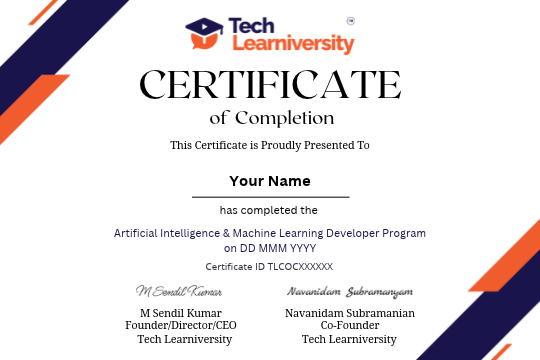
Certification of Completion
Tech Learniversity is proud to uphold ISO 9001:2015 Certified Quality Management System standards, reflecting our strong commitment to excellence and continual improvement. By adhering to globally recognized best practices, we deliver courses and services with consistent quality, reliability, and transparency.
Our QMS framework ensures that every training module—whether in Artificial Intelligence & Machine Learning Developer Program
—follows meticulous processes for development, review, and learner support.
Ultimately, this certification demonstrates our pledge to meet and exceed the expectations of students and industry partners, cultivating trust and long-term success in all our educational offerings.

Quality Education from Quality People
Choose Tech Learniversity for quality education from industry experts committed to empowering your success. Embark on a transformative educational journey with Tech Learniversity and unlock your potential for a brighter future. Together, we can create meaningful experiences that inspire growth, collaboration, and success!
Exceptional Student Satisfaction
Impressive Job Placement Success
Diverse Course Offerings
Global Reach
“

What Our Students Say?
More than 99% students satisfaction is our success.
Oscar Frimpong
Fiorella Reynoso Donzelli
joe riah
Billy Oscar
Frequently Asked Questions
1. Is this AI & Machine Learning Program suitable for beginners?
2. Do I need previous Python programming knowledge?
3. Is mathematics required to learn Machine Learning?
4. Will I learn Machine Learning algorithms?
5. Does this course include Deep Learning?
6. Will I learn Generative AI and Large Language Models?
7. Will I learn Retrieval-Augmented Generation?
8. Does this course include real-world projects?
9. Will I learn to deploy AI applications?
10. Do I need a powerful GPU laptop?
11. Will I receive a certificate?
12. Does this course include an official AWS or Microsoft certification?
13. Can I become an AI or Machine Learning Engineer after this course?
14. Will I build a professional AI/ML portfolio?
15. What is the difference between Machine Learning and Generative AI?
16. Does the course include technical interview preparation?
17. What is the difference between this course and the Data Scientist Professional Training Program?

Get in Touch with Tech Learniversity!
Build Your Career with Tech Learniversity!
Address Business
Hindustan C. Bus Stop,
Lal Bahadur Shastri Rd,
Gandhi Nagar, Vikhroli West,
Mumbai - 400079,
Maharashtra, India
Contact With Us
HR: (+91) 70217 89240
Email Address
hr@techlearniversity.com
Working Time
Sunday/Holiday : Closed