

Data Scientist Program
Accelerate your career with Tech Learniversity’s Data Scientist Program—unlock the power of advanced analytics, machine learning, and AI.
- Home Main
- Data Scientist Program
Course Details
From: Tech Learniversity
Start Day: Coming Soon
Project Duration: 430 Hours
Get in Touch with Tech Learniversity
Call us directly or email us!
Address Business
Hindustan C. Bus Stop,
Lal Bahadur Shastri Rd,
Gandhi Nagar, Vikhroli West,
Mumbai - 400079,
Maharashtra, India
Contact With Us
HR: (+91) 70217 89240
business@techlearniversity.com
hr@techlearniversity.com
Working Time
Holiday : Closed

Data Scientist Program
This Data Scientist Program is an intensive journey through data science foundations, statistical analysis, machine learning, deep learning, and model deployment. Delivered over 400+ hours, it equips students with practical, industry-relevant skills—from Python programming and database queries to advanced AI and MLOps—to solve complex business problems.
Course Type
– Designed for a beginner-to-intermediate level.
– Intensifies into advanced machine learning and deep learning concepts, making it robust for those with basic math/programming backgrounds.
Duration
430 Hours
Requirements
– A computer (Windows, macOS, or Linux) with enough RAM (at least 8 GB recommended)
– Reliable internet connection
– Ability and willingness to install software (Python, SQL databases, IDEs, etc.)
Pre-requisites
– Basic knowledge of linear algebra (e.g., matrices, vectors) and calculus (differentiation, integration)
– Introduction to programming concepts (ideally in Python)
– Understanding of fundamental statistics (mean, variance, distributions) is helpful
Target Audience
– Beginners or early-career professionals targeting Data Science roles
– Software developers aiming to pivot into ML/AI fields
– Statisticians and mathematicians wanting to apply computational techniques
– Data analysts seeking advanced modeling and deployment capabilities
– Professionals from any domain interested in harnessing big data for actionable insights
Career and Future Prospects
Upon completion, graduates can explore roles such as:
– Data Scientist / Research Scientist
– Machine Learning Engineer
– AI Specialist
– Data Analyst (with advanced modeling focus)
– Business Intelligence Specialist (enhanced with data science skills)
With experience, Data Scientists often become team leads, architects, or strategy consultants, shaping AI-driven products and initiatives.
Designation/Title
Common positions in this field include:
– Junior Data Scientist / Associate Data Scientist
– Data Scientist
– Senior Data Scientist
– AI/ML Engineer
– Applied Research Scientist (focus on R&D)
Course Fee
INR. 100000
Curriculum
Python for Data Science: Advanced topics including list comprehensions, lambda functions, decorators, generators. Focus on PEP 8 standards and efficient code.
Libraries:
NumPy
Array creation: np.array(), np.zeros(), np.ones(), np.arange()
Indexing/slicing: array[0:5], array[:, 1]
Element-wise operations: +, -, *, /
Broadcasting rules
Linear algebra: np.dot(), np.matmul(), np.linalg.inv()
Statistics: np.mean(), np.median(), np.std()
Random: np.random.rand(), np.random.randint()
SciPy:(optimization, signal processing).
Data Structures: Efficient use of dictionaries, sets, tuples, and custom classes for data handling (e.g., average O(1) lookup for hash tables).
Version Control: Git and GitHub for collaborative development (branching, merging, pull requests, contributing to open source).
Descriptive Statistics: Measures of central tendency (mean, median, mode), dispersion (variance, standard deviation, IQR), distribution shapes (skewness, kurtosis).
Inferential Statistics: Hypothesis testing (Z-test, T-test, ANOVA, Chi-squared, p-values, significance levels), confidence intervals (95% CI common standard).
Probability Theory: Bayes’ Theorem, conditional probability, joint and marginal distributions.
Regression Analysis: Simple and multiple linear regression (R-squared, adjusted R-squared, RMSE), logistic regression for binary classification.
Experimental Design: A/B testing methodologies, power analysis (achieve 80% power at 0.05 significance level).
SQL for Data Science: Complex queries (JOINs, subqueries, window functions), database design (normalization, indexing for performance: 10-100x faster queries).
CREATE INDEX
DROP INDEX, ALTER INDEX
CREATE VIEW
DROP VIEW, ALTER VIEW
CREATE SEQUENCE
CREATE PROCEDURE / CREATE FUNCTION: Defining parameterized routines
Control flow (IF/ELSE, WHILE loops, CASE statements)
ROW_NUMBER(), RANK(), DENSE_RANK(), NTILE()
LEAD(), LAG(), FIRST_VALUE(), LAST_VALUE()
Aggregate window functions (SUM() OVER(…), AVG() OVER(…))
Data Acquisition: APIs (RESTful, SOAP, OAuth authentication), web scraping (BeautifulSoup, Scrapy for 1000s of pages/hour), data lakes/warehouses.
Pandas for Data Manipulation: DataFrames, Series,GroupBy operations, merging, reshaping (pivot, melt), handling missing data (imputation techniques: mean, median, mode, K-NN), outlier detection (IQR, Z-score).
Create DataFrame: pd.DataFrame()
Import/export: pd.read_csv(), df.to_csv()
Data inspection: df.head(), df.info(), df.describe()
Missing values: df.isnull(), df.fillna(), df.dropna()
Duplicates: df.drop_duplicates()
Selection: df[‘col’], df.loc[], df.iloc[]
Filtering: df[df[‘col’] > 10]
Transformations: df.apply(), df.map(), df.transform()
Grouping: df.groupby()
Merge/join: pd.merge(), pd.concat()
Pivot/melt: df.pivot_table(), pd.melt()
Feature Engineering: Creating new variables from existing ones (e.g., polynomial features, interaction terms, date/time features), encoding categorical variables (one-hot, label, target encoding).
Exploratory Data Analysis (EDA): Univariate, bivariate, multivariate analysis, correlation matrices (Pearson, Spearman coefficients), distribution plots, scatter plots, box plots.
Supervised Learning:
Classification: k-Nearest Neighbors, Naive Bayes, Support Vector Machines (SVMs), Decision Trees, Random Forests (often 5-10% accuracy boost over single trees), Gradient
Boosting (XGBoost, LightGBM, CatBoost: often top performers in Kaggle competitions).
Regression: Ridge, Lasso, Elastic Net regularization.
Unsupervised Learning:
Clustering: K-Means, DBSCAN, Hierarchical Clustering (evaluating with Silhouette score, Elbow method).
Dimensionality Reduction: Principal Component Analysis (PCA: e.g., reducing 100 features to 10 while retaining 95% variance), t-SNE, UMAP.
Model Evaluation: Cross-validation (K-fold), performance metrics (accuracy, precision, recall, F1-score, ROC-AUC for classification; MAE, MSE, R-squared for regression), confusion matrices.
Model Selection & Hyperparameter Tuning: Grid Search, Random Search, Bayesian Optimization (e.g., using Optuna or Hyperopt, can find optimal hyperparameters 2-5x faster).
Neural Networks: Perceptrons, Multi-Layer Perceptrons (MLPs), activation functions (ReLU, sigmoid, tanh), backpropagation.
Frameworks: TensorFlow 2.x, Keras, PyTorch.
Convolutional Neural Networks (CNNs): Image classification (e.g., ResNet, VGG for ImageNet-scale tasks), object detection (YOLO, Faster R-CNN).
Recurrent Neural Networks (RNNs): LSTMs, GRUs for sequence data (NLP, time series).
Natural Language Processing (NLP): Text preprocessing (tokenization, stemming, lemmatization), Word Embeddings (Word2Vec, GloVe), Transformers (BERT, GPT-3 for SOTA NLP tasks).
Model Deployment: Flask/Streamlit for web apps, Docker for containerization, cloud platforms (AWS Sagemaker, Google AI Platform, Azure ML).
MLOps: CI/CD for ML pipelines, model monitoring (data drift, concept drift), logging, versioning.
Big Data Tools: Apache Spark (processing petabytes of data 100x faster than Hadoop MapReduce), Hadoop, Hive, Kafka for real-time data streams.
Data Visualization & Storytelling: Matplotlib, Seaborn, Plotly, Tableau/Power BI. Effective communication of insights to non-technical stakeholders (e.g., “storytelling with data”).
Ethics in AI: Bias in data and models (e.g., racial bias in facial recognition), fairness, accountability, transparency, privacy (GDPR, CCPA compliance).
Case Studies & Projects: End-to-end projects demonstrating problem definition, data acquisition, model building, evaluation, and deployment.
Capstone Project: A comprehensive, real-world project demonstrating proficiency across all syllabus modules, leading to a deployable solution and presentation.
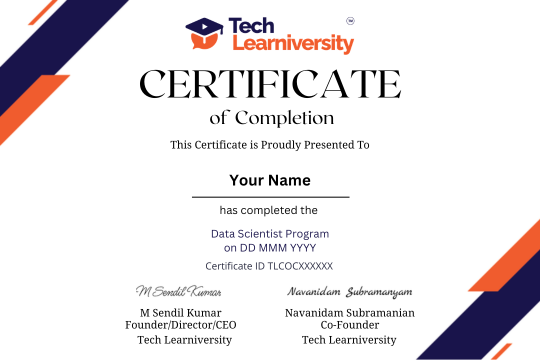
Certification of Completion
Tech Learniversity is proud to uphold ISO 9001:2015 Certified Quality Management System standards, reflecting our strong commitment to excellence and continual improvement. By adhering to globally recognized best practices, we deliver courses and services with consistent quality, reliability, and transparency.
Our QMS framework ensures that every training module—whether in Data Scientist Program—follows meticulous processes for development, review, and learner support.
Ultimately, this certification demonstrates our pledge to meet and exceed the expectations of students and industry partners, cultivating trust and long-term success in all our educational offerings.

Quality Education from Quality People
Choose Tech Learniversity for quality education from industry experts committed to empowering your success. Embark on a transformative educational journey with Tech Learniversity and unlock your potential for a brighter future. Together, we can create meaningful experiences that inspire growth, collaboration, and success!
Exceptional Student Satisfaction
Impressive Job Placement Success
Diverse Course Offerings
Global Reach
“

What Our Students Say?
More than 99% students satisfaction is our success.
Oscar Frimpong
Fiorella Reynoso Donzelli
joe riah

Billy Oscar
Program Questions
Explore common questions about the program.
What will I learn in the Data Scientist Program?
How long is the Data Scientist Program?
Do I need prior programming experience?
What Python and data processing skills will I learn?
Will I learn statistics and probability?
What machine learning skills will I learn?
Will I learn deep learning and AI?
Will I learn SQL and data collection techniques?
Will I learn how to deploy machine learning models?
Will I work on practical Data Science projects?
Didn’t Find the Answer? Ask us Questions
Call us directly or email us!
Address Business
Hindustan C. Bus Stop,
Lal Bahadur Shastri Rd,
Gandhi Nagar, Vikhroli West,
Mumbai - 400079,
Maharashtra, India
Contact With Us
HR: (+91) 70217 89240
business@techlearniversity.com
hr@techlearniversity.com
Working Time
Holiday : Closed
Frequently Asked Questions
How can Data Science skills be applied?
What is the difference between a Data Analyst and a Data Scientist?
What industries can Data Scientists work in?
How does the capstone project help learners?

Get in Touch with Tech Learniversity!
Build Your Career with Tech Learniversity!
Address Business
Hindustan C. Bus Stop,
Lal Bahadur Shastri Rd,
Gandhi Nagar, Vikhroli West,
Mumbai - 400079,
Maharashtra, India
Contact With Us
Email Address
hr@techlearniversity.com
Working Time
Sunday/Holiday : Closed