

Full Stack Java Developer Program
Elevate your career as a Full Stack Java Developer with our comprehensive program that covers essential frontend and backend technologies, database management, DevOps practices, and cloud deployment, equipping you with the skills to build robust applications.
- Home Main
- Full Stack Java Developer Program
Course Details
From: Tech Learniversity
Start Day: Coming Soon
Project Duration: 140 Hours
Get in Touch with Tech Learniversity
Call us directly or email us!
Address Business
Hindustan C. Bus Stop,
Lal Bahadur Shastri Rd,
Gandhi Nagar, Vikhroli West,
Mumbai - 400079,
Maharashtra, India
Contact With Us
HR: (+91) 70217 89240
business@techlearniversity.com
hr@techlearniversity.com
Working Time
Holiday : Closed

Full Stack Java Developer Program
The Full Stack Java Developer Program by Tech Learniversity is designed to equip learners with the skills necessary to excel in both frontend and backend development, covering essential technologies, databases, DevOps practices, and cloud deployment.
Course Type
This program caters to a beginner-to-intermediate audience. It provides foundational theory for newcomers while offering substantial hands-on exercises to deepen skills for those with some exposure to programming and web development.
Duration
140 Hours
Requirements
– Basic understanding of programming concepts.
– Some familiarity with HTML, CSS, and JavaScript is beneficial.
Pre-requisites
To ensure a smooth learning experience and maximize your success in the Full Stack Java Developer Program, the following prerequisites are recommended:
– Basic Understanding of Programming: Familiarity with fundamental programming concepts such as variables, control structures, and data types will be beneficial.
– Familiarity with HTML, CSS, and JavaScript: A basic understanding of these frontend technologies is helpful, as they form the foundation for building user interfaces.
– Willingness to Learn: A passion for web development and a commitment to learning new technologies and frameworks.
Target Audience
– Aspiring Business Analysts from non-IT or IT backgrounds
– Project managers or coordinators aiming to strengthen BA skills
– Professionals transitioning to analysis-centric roles (e.g., domain experts, operations specialists)
– Recent graduates looking to build a BA-focused career path
Career and Future Prospects
Java Full Stack Developers are in high demand globally. Successful learners can work as:
– Java Full Stack Developer
– Software Engineer
– Web Application Developer
– Backend Developer
Industries Hiring
– IT Services
– E-commerce
– Finance
– Education
– Healthcare
Designation/Title
– Full Stack Java Developer
– Software Engineer
– Application Developer
Course Fee
INR. 50000
Curriculum
1.1 HTML (HyperText Markup Language)
● HTML5 Structure & Elements
● Forms and Form Validation
● Semantic Elements
● Audio, Video, and SVG
1.2 CSS (Cascading Style Sheets)
● CSS Selectors & Properties
● Box Model & Positioning
● Flexbox and Grid Layout
● CSS Transitions & Animations
● Responsive Design (Media Queries)
● Bootstrap 5 Framework
1.3 JavaScript (ES6 & Beyond)
● JavaScript Basics: Variables, Data Types, Operators
● Functions, Arrays, Loops, and Conditional Statements
● DOM Manipulation
● Event Handling
● Asynchronous JavaScript (Callbacks, Promises, Async/Await)
● LocalStorage & SessionStorage
● Fetch API & Axios for HTTP Requests
● Introduction to React.js
● JSX & Virtual DOM
● Components & Props
● State & Lifecycle Methods
● React Hooks (useState, useEffect, useContext)
● React Router (Navigation & Routing)
● Redux (State Management)
● API Integration in React
● React Testing (Jest, React Testing Library)
● Java Basics: Data Types, Operators, Variables
● Control Statements (If-Else, Loops, Switch)
● Arrays & Strings
● Object-Oriented Programming (OOPs)
○ Classes & Objects
○ Constructors & Methods
○ Inheritance & Polymorphism
○ Abstraction & Encapsulation
○ Interfaces & Abstract Classes
● Exception Handling
● Collections Framework (List, Set, Map, Queue)
● File Handling in Java
● Multithreading & Concurrency
● Lambda Expressions & Stream API
4.1 Spring Framework & Spring Boot
● Introduction to Spring Boot
● Spring Boot Architecture
● Dependency Injection & Inversion of Control (IoC)
● Spring Boot Annotations
● Spring Boot REST APIs
● Handling HTTP Requests & Responses
● Exception Handling in Spring Boot
4.2 Spring Boot with Database
● JDBC vs JPA vs Hibernate
● Spring Data JPA with Hibernate
● Creating & Managing Entities
● CRUD Operations with JPA
● Querying Data with JPQL
● Using Spring Boot with MySQL/PostgreSQL
4.3 RESTful Web Services
● REST API Basics & Principles
● Building RESTful Services in Spring Boot
● Consuming REST APIs with Postman
● Authentication & Authorization in REST APIs
● Role-Based Access Control (RBAC)
5.1 SQL & Relational Databases
● Introduction to Databases
● SQL Commands (DDL, DML, DCL, TCL)
● Joins, Group By, Aggregate Functions
● Stored Procedures & Triggers
● Indexing & Optimization
5.2 NoSQL Database (MongoDB)
● Introduction to NoSQL
● Installing & Using MongoDB
● CRUD Operations in MongoDB
● Querying Data in MongoDB
● MongoDB with Java Spring Boot
● Introduction to Web Security
● User Authentication using Spring Security
● Role-Based Authorization
● JWT (JSON Web Tokens) Authentication
● OAuth2 Implementation
● Password Hashing with BCrypt
7.1 Git & GitHub
● Version Control Basics
● Git Commands (Commit, Push, Pull, Merge)
● GitHub Repositories & Branching
● CI/CD Pipelines
7.2 Docker & Kubernetes
● Introduction to Docker
● Dockerizing a Spring Boot App
● Introduction to Kubernetes
7.3 Cloud Deployment (AWS/GCP/Azure)
● Deploying Spring Boot App on AWS EC2
● AWS S3 for File Storage
● Database Deployment on AWS RDS
● Introduction to Microservices Architecture
● Monolithic vs Microservices
● Spring Cloud & Netflix Eureka
● API Gateway (Zuul, Spring Cloud Gateway)
● Inter-Service Communication (Feign Client)
● Circuit Breaker Pattern (Resilience4j)
● Event-Driven Architecture (Apache Kafka)
● Unit Testing with JUnit & Mockito
● API Testing with Postman
● Integration Testing in Spring Boot
● Performance Testing with JMeter
● Full-Stack Java Project Implementation
● Debugging & Code Optimization
● Best Practices for Java Development
● Java Full Stack Interview Questions
Project 1: E-Commerce Application
● User Authentication (Spring Security + JWT)
● Product Catalog Management (React + Spring Boot + MySQL)
● Shopping Cart & Order Processing
● Payment Gateway Integration
Project 2: Online Learning Management System
● Admin Panel for Course Management
● User Dashboard for Students & Teachers
● Video Streaming & Chat Features
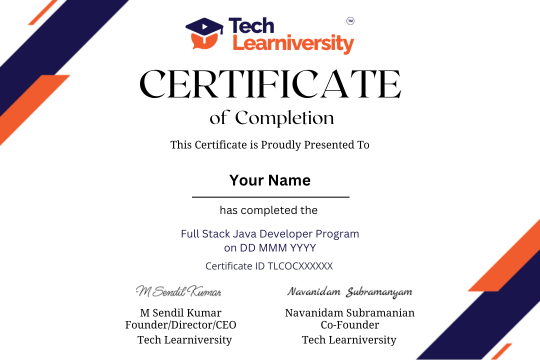
Certification of Completion
Tech Learniversity is proud to uphold ISO 9001:2015 Certified Quality Management System standards, reflecting our strong commitment to excellence and continual improvement. By adhering to globally recognized best practices, we deliver courses and services with consistent quality, reliability, and transparency.
Our QMS framework ensures that every training module—whether in Full Stack Java Developer Program—follows meticulous processes for development, review, and learner support.
Ultimately, this certification demonstrates our pledge to meet and exceed the expectations of students and industry partners, cultivating trust and long-term success in all our educational offerings.

Quality Education from Quality People
Choose Tech Learniversity for quality education from industry experts committed to empowering your success. Embark on a transformative educational journey with Tech Learniversity and unlock your potential for a brighter future. Together, we can create meaningful experiences that inspire growth, collaboration, and success!
Exceptional Student Satisfaction
Impressive Job Placement Success
Diverse Course Offerings
Global Reach
“

What Our Students Say?
More than 99% students satisfaction is our success.
Oscar Frimpong
Fiorella Reynoso Donzelli
joe riah

Billy Oscar
Program Questions
Explore common questions about the program.
What will I learn in the Full Stack Java Developer Program?
How long is the Full Stack Java Developer Program?
What frontend technologies will I learn?
Will I learn React.js?
What Java skills will I learn?
Will I learn backend development with Spring Boot?
What database technologies will I learn?
Will I learn application security and authentication?
Will I learn DevOps, cloud deployment, and microservices?
Will I work on practical projects?
Didn’t Find the Answer? Ask us Questions
Call us directly or email us!
Address Business
Hindustan C. Bus Stop,
Lal Bahadur Shastri Rd,
Gandhi Nagar, Vikhroli West,
Mumbai - 400079,
Maharashtra, India
Contact With Us
HR: (+91) 70217 89240
business@techlearniversity.com
hr@techlearniversity.com
Working Time
Holiday : Closed
Frequently Asked Questions
What is the difference between frontend and backend development?
Why is Java used for full stack development?
What is the difference between a monolithic application and microservices?
How do the practical projects help learners?

Get in Touch with Tech Learniversity!
Build Your Career with Tech Learniversity!
Address Business
Hindustan C. Bus Stop,
Lal Bahadur Shastri Rd,
Gandhi Nagar, Vikhroli West,
Mumbai - 400079,
Maharashtra, India
Contact With Us
Email Address
hr@techlearniversity.com
Working Time
Sunday/Holiday : Closed